By Sophia McCauley, English, Creative Writing, Literature and Culture major with a History minor, class of 2026, fall 2025 University Archives intern working with Bill Kimok.
Introduction and Processing
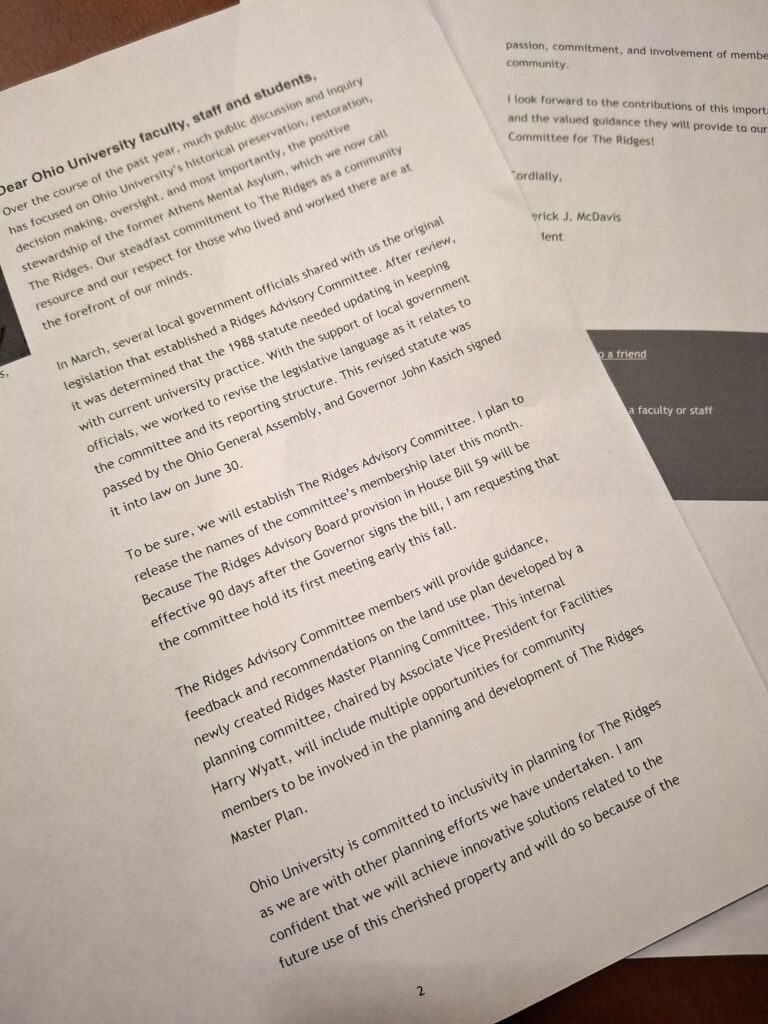
Throughout this 2025 fall semester, I have had the honor and pleasure of processing the President Roderick J. McDavis, (2004-2017) Collection, the Faculty Collective Bargaining Attempt Collection, (1974-75) and the Ohio University Recruitment and Admissions Collection. Since most of my weeks as an intern were dedicated to the files pertaining to President McDavis, I have become somewhat of an expert on these files and on this time period as a whole. I will admit that in the beginning, I was a bit daunted by five full boxes staring at me from the corner as I began reviewing the contents, removing staples from papers, and aimlessly scribbling down everything I saw in each folder. The process began to move a bit quicker once I was able to sort papers by date and organize them into new folders that I labeled. This is when I was able to read more deeply into these topics, and immerse myself in the collection. Once the collection was organized, I was then able to use the Excel spreadsheet to formally document every piece, and this spreadsheet was then submitted to the ArchivesSpace database to be used as a finding aid for interested researchers.
Historical Context
Roderick J. McDavis was the 20th president of Ohio University, and he was installed on July 1, 2004, when he became the first African American, and only the second alum, to become president of OHIO. McDavis attended Ohio University as an undergraduate student during the late 1960s, obtaining a bachelor’s degree in 1970. He then went on to obtain his master’s at the University of Dayton in 1971, and finally he earned his doctorate in counselor education and higher education administration from the University of Toledo in 1974. The materials in this collection dive deep into the accomplishments of his administration during his presidency.
Interesting finds
Task Force
One of the most interesting findings in this collection, was the material related to President McDavis’s membership on a state-wide task force for which the purpose was to promote higher education across the Ohio. At the time that the committee was formed, Ohio ranked 38th in the nation in residents who had earned at least a Bachelor’s Degree. Therefore, the committee, which was formed by Ohio Chancellor Jim Petro, was tasked with trying to increase the percentage of Ohioans earning a four-year college degree. A secondary aim of the task force was to improve Ohio’s economy by turning out better educated Ohioans. Within the task force there were groups that worked statewide on enhancing preparedness for college; people working on minimizing the time necessary for obtaining a degree once people entered college; and a group that worked to reward Ohio students upon completion of their degree. McDavis was asked to be the chair of the Academia subgroup and he received numerous letters and accolades thanking him for his participation and representation of Ohio University within the task force.
Public reactions to student high-risk drinking concerns
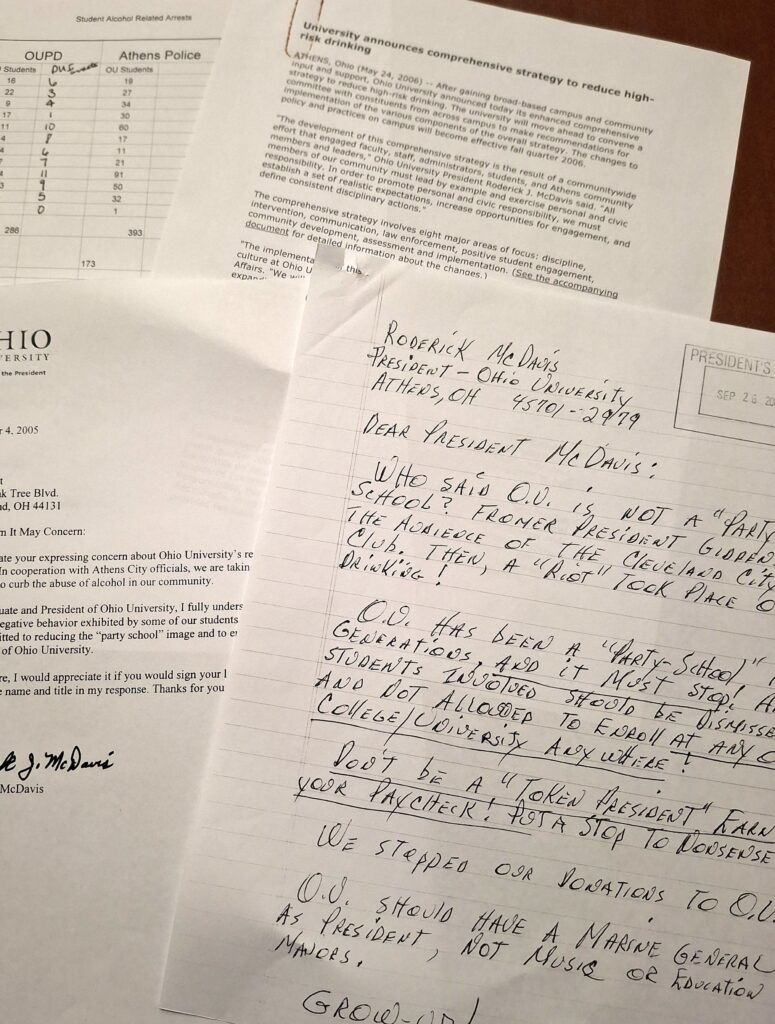
Throughout the modern history of OHIO, the university had become known as a so-called “party school.” By the early years of the McDavis administration, this reputation had become a publicity problem for the University. In the McDavis papers I found letters addressed to McDavis from parents, outraged donors, and the general community about the impact alcohol was having on campus and in Athens at the time. Letters suggested that the president should “put a stop to this nonsense” and “earn [his] paycheck”. Some regular stakeholders even went as far as to pull their donations, and others expressed concern that the president was losing control of the campus. One letter exclaimed that, “O.U. should have a marine general as president, not music or education majors. Grow-up!”. A few parents wrote letters expressing their anger in the fact that their child was exposed to this behavior, and others wrote protesting that their child was punished for this behavior and they were not made aware. The McDavis papers show that the president took this seriously and looked for ways to change things. There were studies done to attempt to understand student behavior in order to see areas of concern. Also located in this collection are suggested disciplinary actions for students abusing alcohol.
My Experience as a Mahn Center Intern
Working in the archives has been one of the most rewarding experiences I have had throughout the course of my undergraduate studies. Since I am an English, Creative Writing, Literature, and Culture major with a History minor, this work was incredibly interesting and incredibly relevant to my time here as a student at the university. Processing not just the McDavis Papers but also the Faculty Collective Bargaining Attempt collection and the OHIO Recruitment and Admissions collection allowed me a broader perspective about university administrative work. I feel as though it has been an incredible experience for me to have had this in-depth look the administrative history of my university which students do not regularly get or take the opportunity to see. To have learned some new skills along the way while doing this has just made it all the more worthwhile and enjoyable.