By Avery Kumes, Honors Tutorial College Classics & Religious Studies, ‘27, Spring 2026 Rare Book intern
My name is Avery Kumes and I am a third year Honors Tutorial College Classics & Religious Studies major. I am broadly interested in a public history career, and after a summer experience processing archival records in the East Tennessee History Center, I was eager to find more opportunities to do this type of research. I have found myself interested not only in the types of materials an institution holds, but how useful they actually are to people and how can that be improved–as in, are these materials findable? Are they digitized? Are they properly and accurately labeled? My internship in the Mahn Center involved working with a collection of original book leaves (i.e. individual pages removed from incidentally or purposefully unbound and disassembled books and manuscripts) called “Pages from the Past” set I: History of the Written Word, versions of which are housed at multiple institutions including Ohio University. The experience has helped me think about these questions as well as how librarians and archivists bridge the gap between the collections they steward and the public.
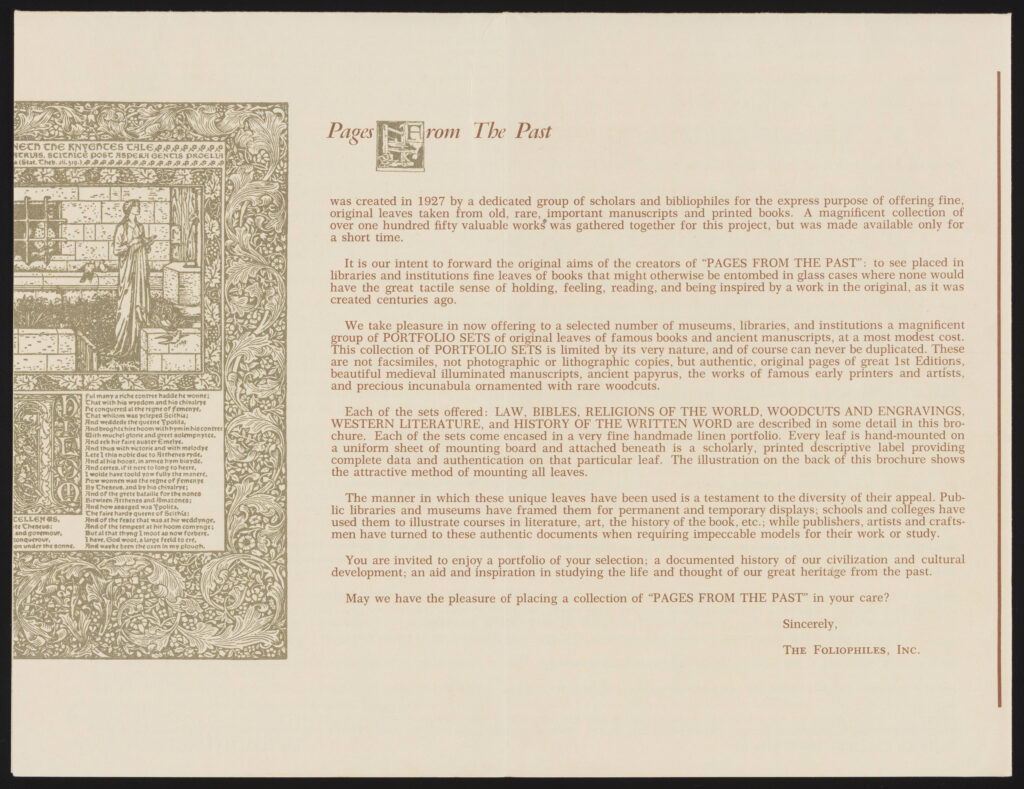
Ohio University Libraries’ Pages from the Past set was compiled and published in May of 1964 by the now-defunct Foliophiles Inc. Foliophiles had been around since the 1920s compiling leaves to make themed sets as teaching aids for libraries and universities. By the 1960s, Foliophiles Inc. was not so much a business as the work of one man, Alfred Stites. Stites’s interesting method-less methods of compiling and describing the contents of these sets has created many snags in our understanding of them, how they were assembled, and where they ended up; untangling these mysteries has been my quite enjoyable but at times Sisyphus-ian task since January.
My Introduction to Pages from the Past
I first heard about the Pages from the Past set last fall in my Ancient Near Eastern Art and Archaeology class. Our professor Dr. Cory Crawford told us that there was a collection in the library that contained ancient artifacts, including a Babylonian clay tablet and a Mesopotamian cylinder seal. Dr. Crawford and staff from Archives & Special Collections and Digital Initiatives had worked with Dr. Lawrence Witmer and students at the WitmerLab on getting these artifacts imaged with a MicroCT scanner in order to create digital files that could be 3D printed for deeper research and as a teaching aid.
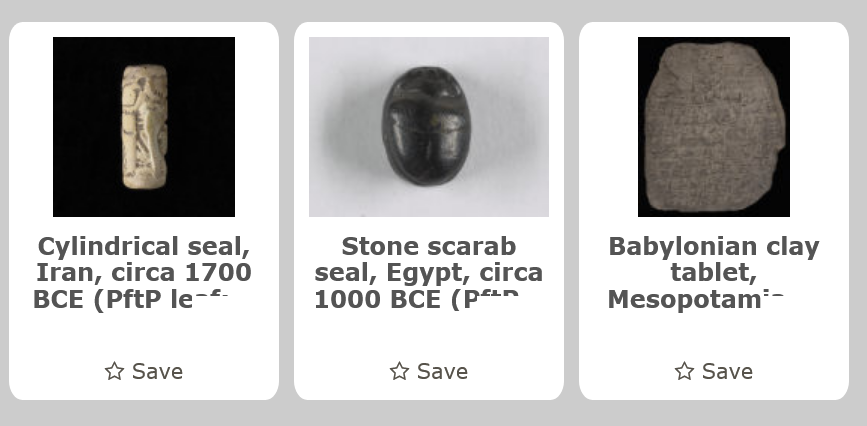
As a classics major, I was delighted that there were opportunities through the Mahn Center’s internship program to work with older materials and when I applied I requested to work with this collection.
Terminology
Before I get into what I worked on, I should clarify a few terms. When I refer to a set, I am referring to the collection of materials put together and sold by the Foliophiles Inc. under the name Pages From the Past set I: History of the Written Word. These sets began to be assembled in the 1920s as teaching aids for universities and libraries; each contained about 150 items. Instead of purchasing many rare books and manuscripts to show students the diversity and evolution over time of print, script styles, methods of book illustration, etc. (which many institutions could not in any case afford), this company put together themed sets to cover as many time periods and types of texts into one affordable set of leaves. “History of the Written Word” is only one theme, there are several other themed portfolios such as Printed Pages from English Literature, Specimens of Woodcuts and Engravings, Pages from Religious Works (not held by Ohio University), and more. We can guess, though, that since all these sets were being put together by the same company, that there are leaves shared between portfolios, regardless of theme.
As far as “History of the Written Word,” there are two runs, or groups of releases, of these sets that I have examined. There are believed to be five runs total: the first edition in 1964 (I), two special versions of the first edition compiled in 1964 but not delivered until 1966 (Ia and Ib–one with 159 leaves and one with 96), a second edition in 1965 (II), and a third edition in 1967 (III). Our set is number 14 of 15 from edition I in 1964. There is another fully digitized set from 1964 (I don’t know which version), located at the University of Western Michigan. There are also two fully digitized sets from the 1967 run, at the Memorial University of Newfoundland, Canada and the University of Missouri. Included in each set was a fold-out index listing what was (supposedly) included in the set, numbered in chronological order, with short, one-sentence descriptions. Ours looks like this:
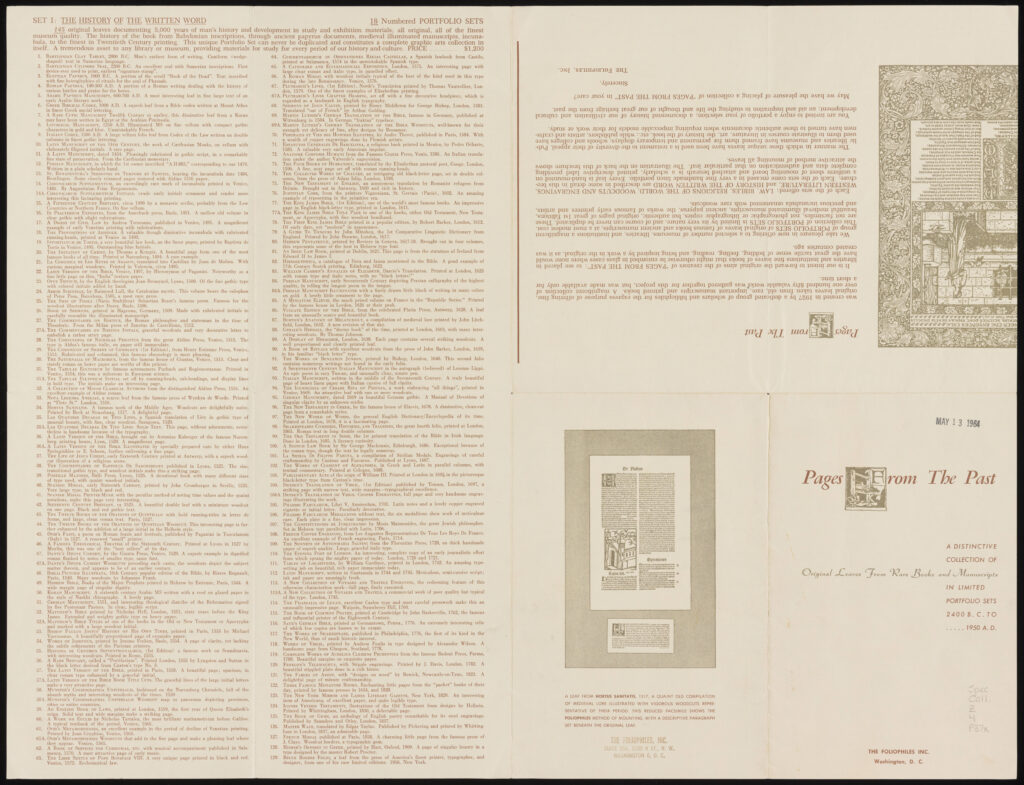
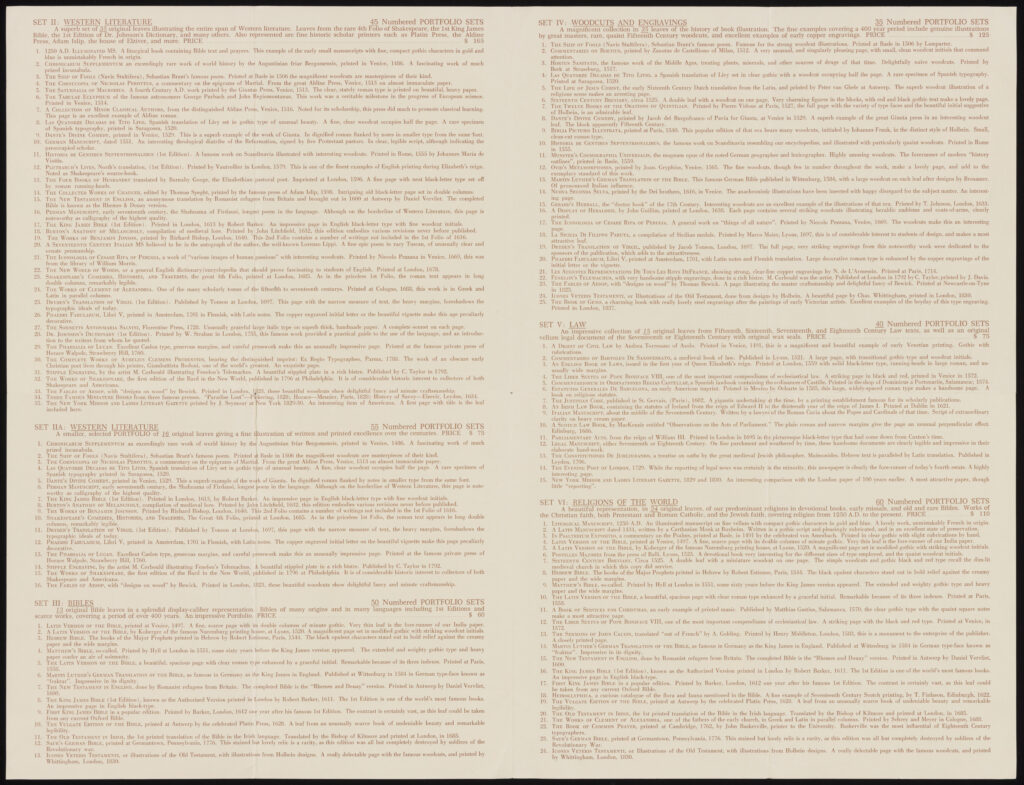
Foldout index included with our Pages from the Past set detailing the contents of the set and information about the Foliophiles. Link to digital items in our collection.
Each leaf also included a label. Originally, they were mounted on a piece of black cardstock with the label pasted beneath. MUN’s collection is still in its original form, which looks like this:
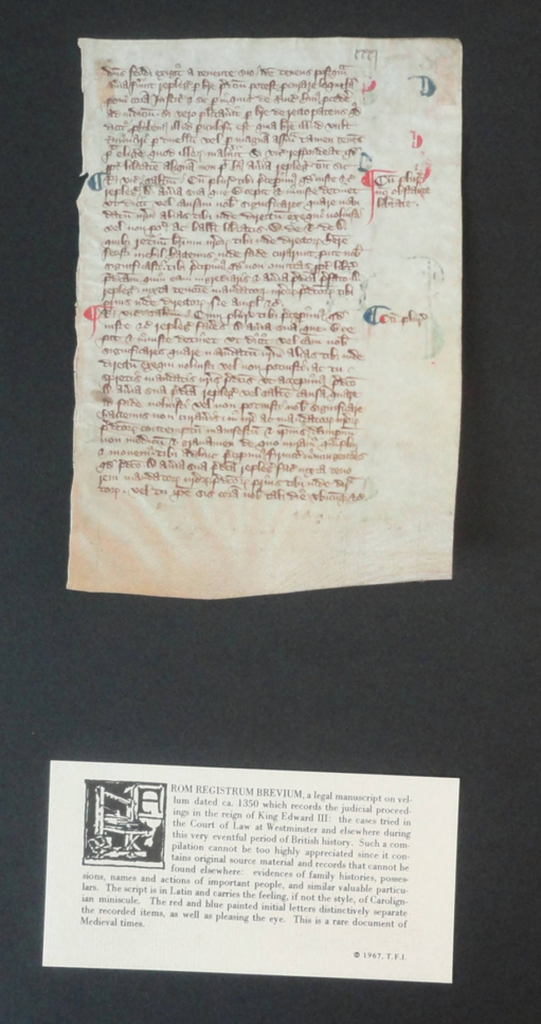
Newfoundland’s #8 leaf, Registrum Brevium, a legal manuscript from 1350. Courtesy of MUN Libraries Archives and Special Collections. Link to digital item in MUN’s collection.
The label descriptions are longer and more detailed than on the indexes, and as far as I can tell, pretty accurate. Usually there will be enough similar details between an index description and a label description to tell if the index is referring to an item actually included in the set, but you cannot always rely on visual similarity. The index descriptions for the medieval manuscript leaves and Persian manuscript leaves provide frustratingly little detail to be sure whether it is the material being described. The only ways to tell would be to read the leaves and thereby deduce whether the subject matter matches the description or to compare scripts, illustrations, substrates, and other technical details, all of which require significant expertise and specialized training. On most of the labels, in the bottom right corner is a copyright date; we assume when the label was printed. This will be important later.
Previous Work on Pages From the Past
Much of what I did built off the work of three previous students who worked on this set in 2021 as part of an independent study. They had researched and helped draft a survey asking about the artifacts included in the sets. Drs. Crawford and Intrator then sent the survey to a number of libraries suspected of having a set. The survey results helped me know for sure which libraries had a collection similar to ours. A former intern had also reconciled the index foldout sheet with the leaves we had, showing what was actually included versus what we were supposed to have. These two efforts were the starting point for the work I did, and I would not have been able to check our collection against other institutions had they not done such careful detail work with ours.
I also owe a great debt of gratitude to Dr. Arthur Askins, Professor Emeritus of Spanish and Portuguese Literature at University of California, Berkeley. Dr. Askins was fascinated by a particular manuscript leaf from Berkeley’s Pages from the Past collection that was mislabeled as Portuguese, but ended up being from a broken Spanish manuscript that was unknown to historians until Askins examined the text. In an attempt to find other leaves from this manuscript, including the one here at Ohio University, Dr. Askins put a lot of time into teasing out the differences between sets, where they were located, and what we can generally expect sets from certain runs to have (he is the one that figured out how many runs of the sets there are). He also got into the weeds of researching Stites’s methods and the origins of the leaves included in the sets. His research, now in the Bancroft Library at UC Berkeley, has greatly benefited mine.
Now, to meet Alfred Stites.
The Foliophiles Inc. & Alfred Stites
Above all, Alfred W. Stites was a businessman, not a book or art historian. Sites created the 1960s sets from a stock of materials purchased from the original Foliophiles Inc., a company started in the 1920s by rare book dealer George M. L. Brown. Brown sold the company name and stock of materials to another man, Harold Maker, in the 1950s, who added additional materials to Brown’s stock, then sold it to Stites in the early 60s. The collection Stites purchased (according to him) consisted of 10,000 leaves, which he used to make sets between 1964-1968. Stites ran Foliophiles for decades though he only produced sets for four years. After moving to Santa Fe in 1969, Stites continued to sell leaves individually and upon his retirement in 2002, sold the rest of the leaves at auction. Since Stites was not trained in rare material handling and selling, there is a lot of mystery surrounding where these materials were acquired from and how he went about putting the sets together.
As I mentioned earlier, a lot of the manuscript leaves are not described in a way that one could definitively match the index description with a leaf from the collection. Additionally, to my untrained eye, I know as much about the contents of the manuscripts as I’d venture to guess Stites did. We don’t know where Stites got the descriptions of his materials, especially the materials that have 1964, 1965, or 1967 as the copyright date on the label. If Stites kept the 1926/7 date on the label, it means he was (generally) using Brown’s original words, and it is worth noting that Brown was a rare book dealer by training and likely knew more about these materials than Stites. Any label dated from the 60s was Stites’s description. It would take years of combined effort from many types of experts to untangle these inconsistencies, I have only tried to keep track of these details to help when or if people try to crack these mysteries.
Research Process
What it boils down to is that there are so many inconsistencies in what these sets contain that there is only one conclusion we could draw about how they were assembled–that there was no real process. The rule was there was no rule!
Map (may be slow to load) of known institutions holding “Pages from the Past” set I: History of the Written Word sets with artifacts. Link to interactive ArcGIS map created by Avery Kumes.
On top of this, you can see by looking at the map above how many known sets there are, and it was intimidating to figure out where to start. I think that was the beauty of this process though; I didn’t start with any particular question to answer, the questions revealed themselves as I worked. The first thing I did before I even attempted to find other sets was to get familiar with ours. I took every single leaf out of the folder, examined the front and back, noted the general size, and paid attention to how it looked visually versus how it was described in the index and label. The familiarity I got from this helped me know off the top of my head when I was looking at leaves from other institutions’ sets whether or not we had something similar, which helped speed up my process.
Our Pages from the Past was so well researched and documented, and Askins had identified so many holes in understanding how the runs differed from each other, why not begin to look outward? So that’s what I did. I began with the survey sent out to other libraries we were pretty sure had a set similar to ours (as in, included the three artifacts ours do–since all of the runs from the 60s include artifacts. This initial survey did not account for the differences between the five runs). I scoured their digital archives to see if they had a digitized collection, or if anyone had done work with their collections like we had. My first hit was at the University of South Florida. Their collection is not entirely digitized and there’s not much information about their sets, but they had 9 images of leaves from their collection, and one matched ours, down to the annotations!
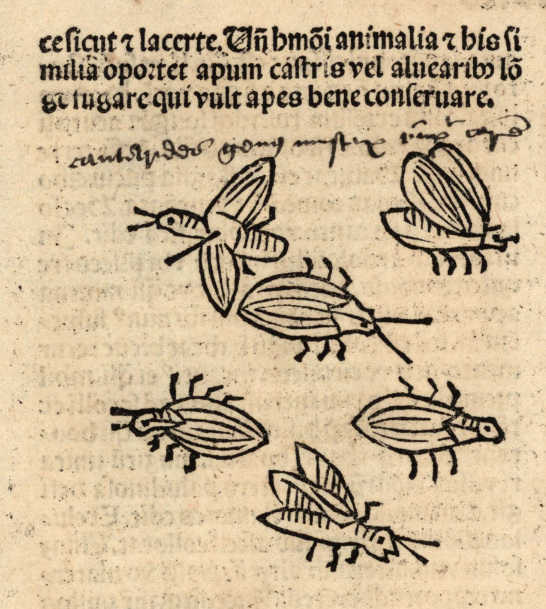
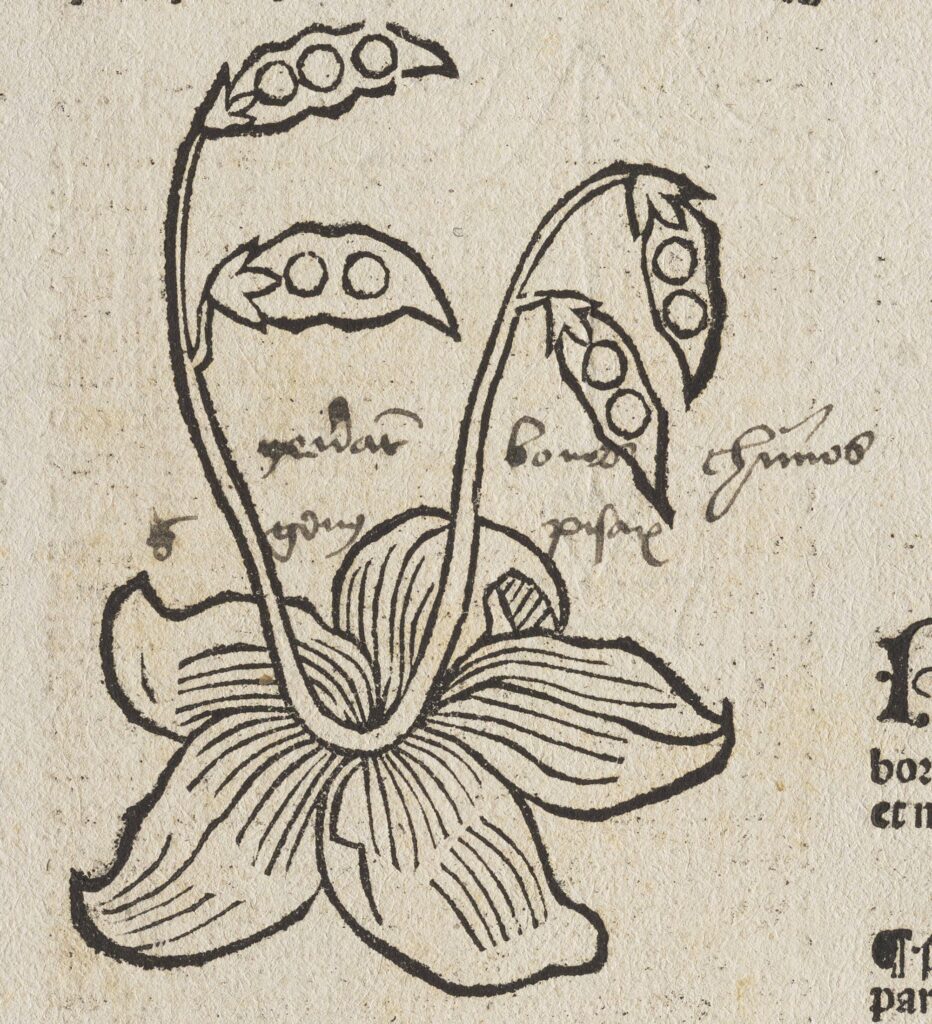
a woodcut of a flower sprouting pods and handwritten
annotations in a similar script to the annotations on USF’s leaf (pictured to the left). Hortus sanitatis, Germany 1517 (PftP leaf: s01, f042). Link to digital item in our collection.
Encouraged, I kept going. I tried larger libraries we had contacted before that I knew had digital archives initiatives. I didn’t have much luck until the Memorial University of Newfoundland. Their collection was not only entirely digitized, but still in its original form: pages mounted on black cardstock with the labels pasted beneath. Their index was not included, so initially I could only cross reference the materials themselves and the labels. I found another fully digitized 1967 collection from the University of Missouri which was wonderful because I could compare it to ours and MUN’s 1967 set. Once I had a few sets to compare, I found some interesting details.
First, most of the materials listed in our index that we were missing could be found in the index and collection of the MUN and UM sets. When I began this project, we thought maybe our set was created later when Stites was trying to get rid of materials. It seemed like he was making sets from a stock of materials that was running out but keeping the same index to be sold with the sets even though it was only about 80% accurate. The fact that the later sets contained materials that we were supposed to have and did not was very interesting; I had assumed he ran out of things and replaced them without correcting the index.
Second, I reached out to UM and MUN’s libraries out of curiosity during the last month of my internship period to see if they still had their index, and MUN did! (Regrettably, Missouri does not still have theirs, but judging on the similarity of what the sets contain I imagine it’s pretty much the same). MUN’s 1967 set, as opposed to ours, was almost completely accurate to its index (only two materials are listed in the index that are not found in the collection), including the manuscript leaves which are notoriously misrepresented in our set. Again, we found it so strange that the later sets were more accurate to their indexes than the earlier ones. But the plot thickens!
During the very last week of this internship, Dr. Crawford showed me another fully digitized collection, at the University of Western Michigan. I had come across a library page with full descriptions for each of their leaves about two months ago, but I did not know the collection had been digitized. This was more exciting because their set was also from 1964. Having gotten to compare two sets from 1967, I now got to compare one from 1964 with ours! The results yielded more questions than answers, as despite also being from 1964, the Western Michigan had almost all the things we are missing and was also pretty consistent with our index. I have yet to get my hands on their index, nor do I know what run of the first edition they have, but it is puzzling that if these sets were created at the same time, why wouldn’t Stites put materials he obviously had in both sets? This and other riveting questions remain!
My general process was that of many spreadsheets. Half the battle was deciding what information to keep track of and how to make it useful at a quick glance. I picked what I thought were the most important questions and made drop down boxes for them in the spreadsheet

This is a good way of keeping track of general differences between the sets. My ultimate desire for these sets would be getting to a point where so many of them have been examined that we know generally what each one should include based on the year it was put together. This would mean researchers like Askins wouldn’t have to go through the trouble of trying to hunt down every set from every year in order to find leaves from a specific manuscript or book. This is a lofty dream; the discovery of the UWM set in the last week showed me just how inaccurate sets from the same edition can be. There are still so many collections out there that need to be examined, especially George Brown’s sets from the 1920s. I am excited about the work that could be done on these sets in the future, there is still so much yet to be uncovered!
Interactive view (may be slow to load) of a leaf from the Scheuchzer Bible, Germany, 1731 (PftP leaf: s01, f132). Zoom in and out and click on the vector points and shadow boxes to read and learn more. Link to interactive ArcGIS image annotated by Avery Kumes.
I have had such a wonderful semester contributing the work the Mahn Center does. I am proud of what I have accomplished, and believe that as we uncover more about these sets, my work will be helpful to future researchers. I have learned so much about the work archivists do behind the scenes, the value of collaboration between institutions, and how valuable digitization can be to making progress on collections such as Pages From the Past. Working out information about these fascinating sets is truly a puzzle to solve, but I have gotten a great deal of enjoyment from untangling these mysteries!
References
Arthur L.-F. Askins research and historical notes on The Foliophiles, Inc., BANC MSS 2011/147. https://search.library.berkeley.edu/permalink/01UCS_BER/op3pcd/alma991078476959706532.
Jacob Meydenbach, “Pages from the Past. History of the Written Word. Various Leaves – No. 31 Hortus Sanitatis” (1491). Sacred Leaves Manuscript Collection. 210. https://digitalcommons.usf.edu/sacred_leaves/210.
Pages from the Past/History of the Written Word, Memorial University of Newfoundland. Libraries. Archives and Special Collections. https://collections.mun.ca/digital/collection/archives/id/6577.
Pages from the past (collection), Rare Books Collection, Special Collections, University of Missouri. https://digital.library.missouri.edu/node/188001.
Pages from the Past, Western Michigan University Special Collections. https://luna.library.wmich.edu/luna/servlet/view/all?sort=identifier%2Ccentury.