By Conrad Burt, History and Music ’27, Fall 2026 Rare Books Intern
Just a few weeks after starting my internship this fall, I made one of the most interesting discoveries of my career in music history, one that produced more historical questions than historical answers. During my time at the Mahn Center, I have occasionally been presented with musical material from the Rare Book Collection to examine, research, and arrive at conclusions on. Research related to the musical works focuses on provenance information, translation or transcription, and other questions about how or why the item came into our possession at Ohio University Libraries. If any of these details are unknown, my job is to figure out the answers with the musical-historical background I’ve developed while at Ohio University.
One such piece of musical material was a copy of an opera manuscript which sets the famous Orpheus myth to music. I didn’t think much of it at first, since the Orpheus myth has been widely reused as libretti material throughout the history of opera going back to the seventeenth century; it had become somewhat of a rite of passage for European opera composers.[1] Something about the manuscript caught my eye, though, and I very quickly realized what I was holding in my hands. This was a hand-copied manuscript of the first ever extant opera in music history!
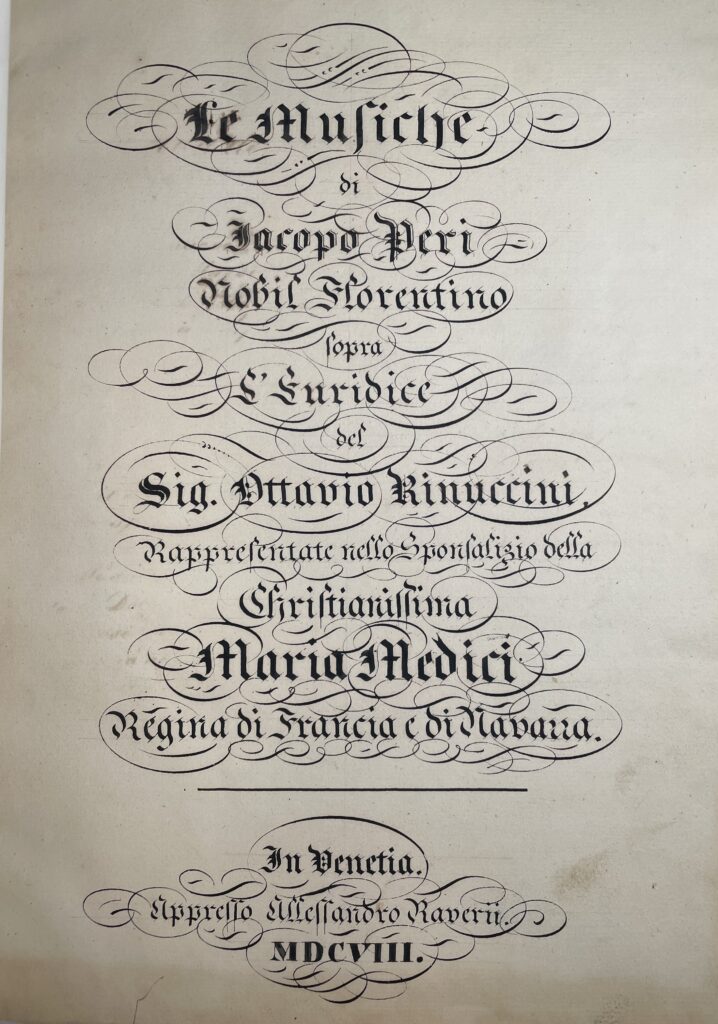
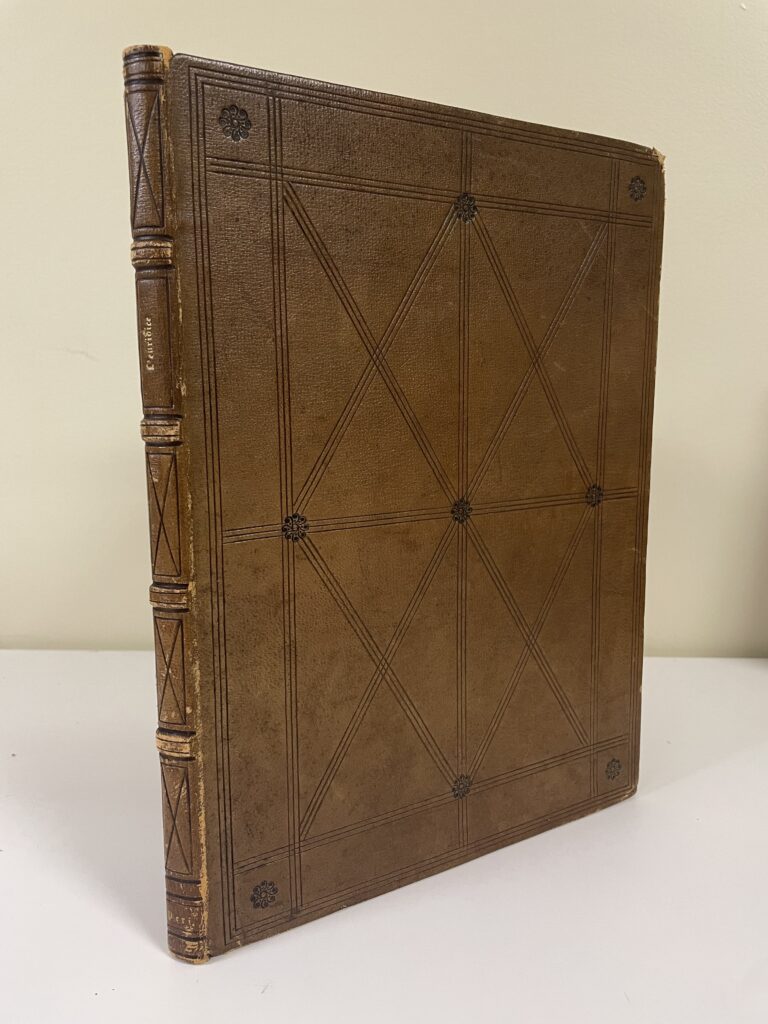
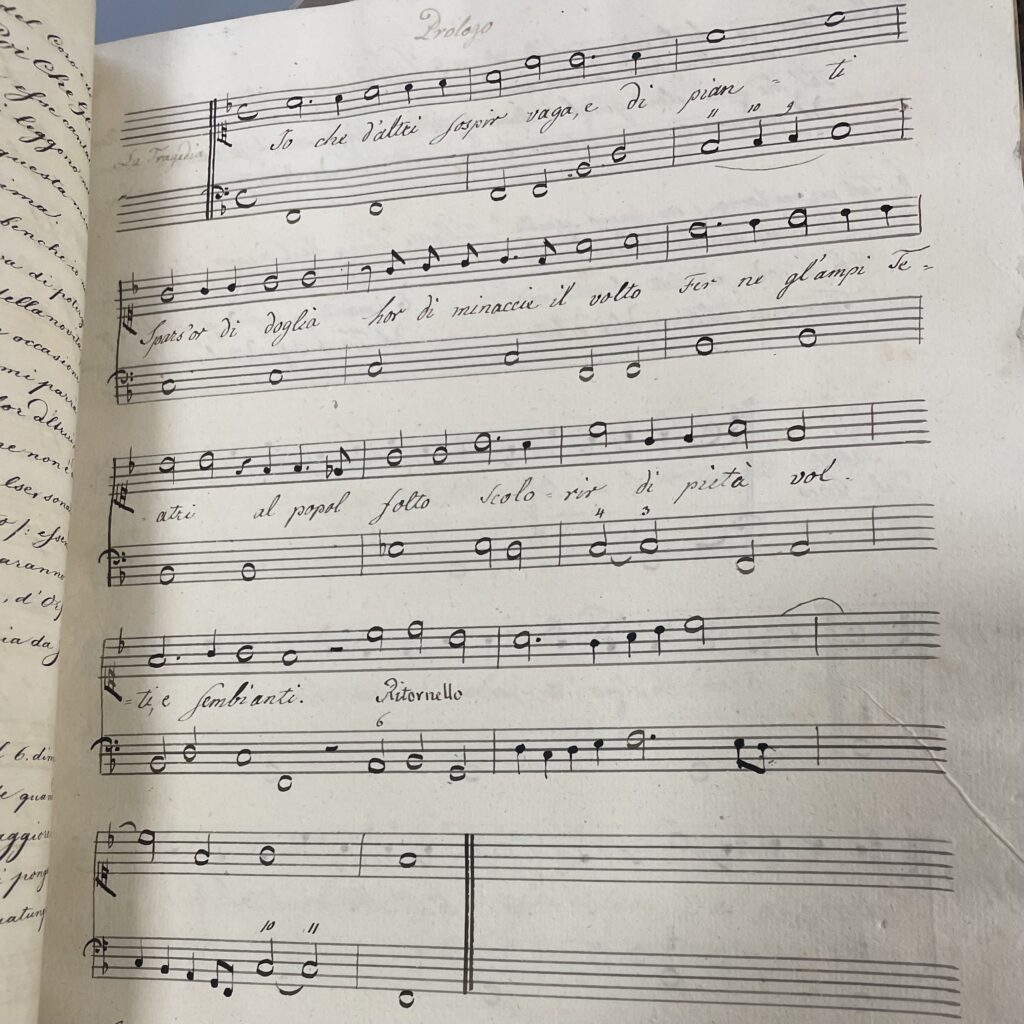
L’Euridice, composed by Jacopo Peri (1561-1633), is a setting of the ‘Orpheus’ myth to music which bases its text on books X and XI of Ovid’s Metamorphoses.
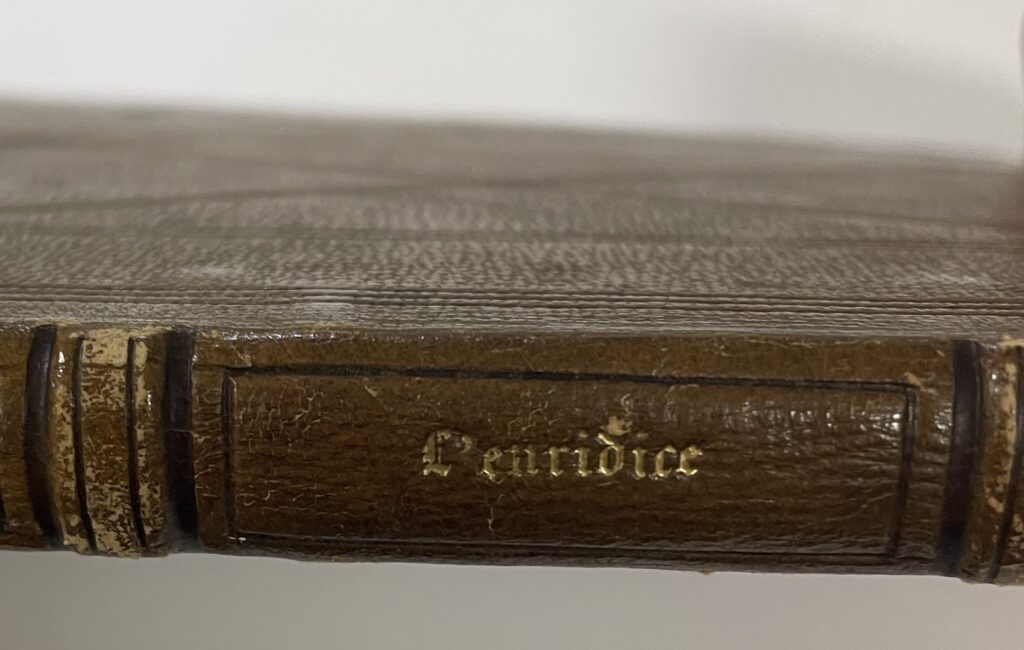
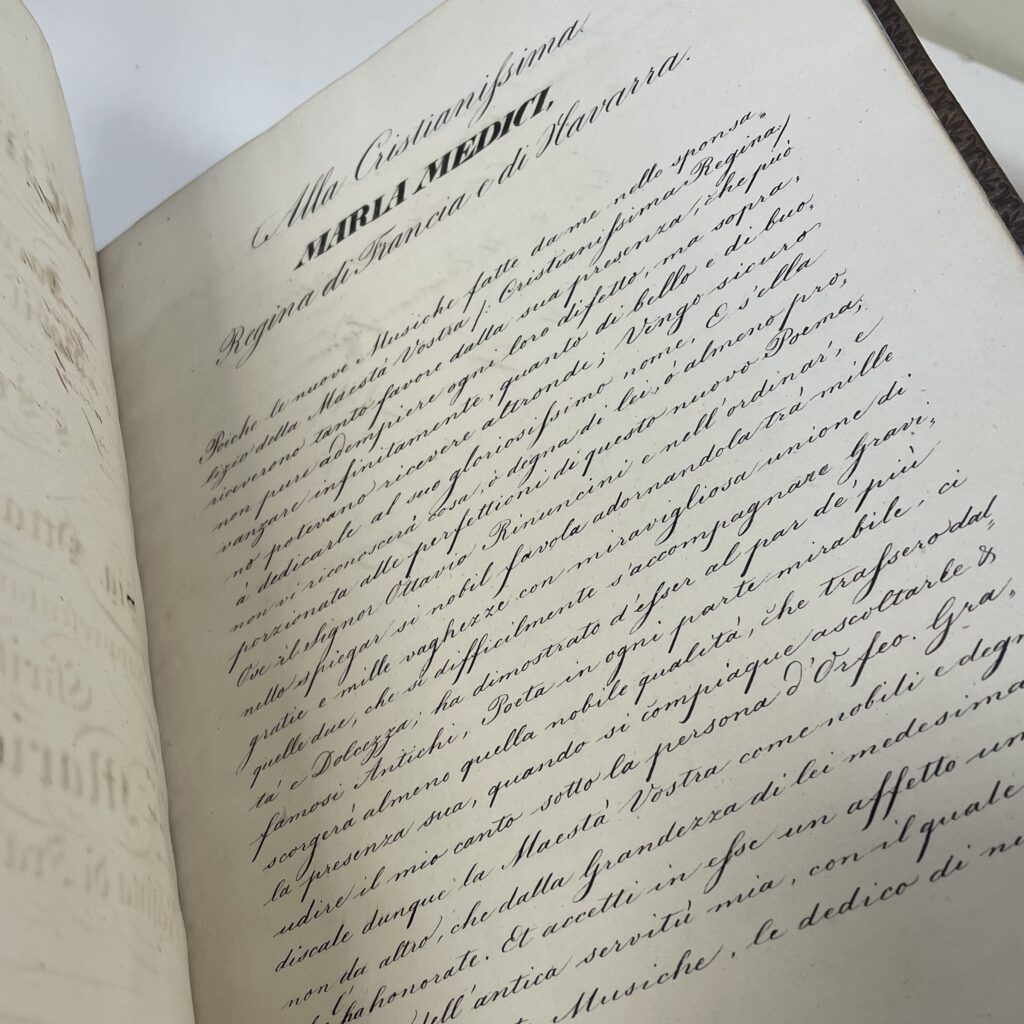
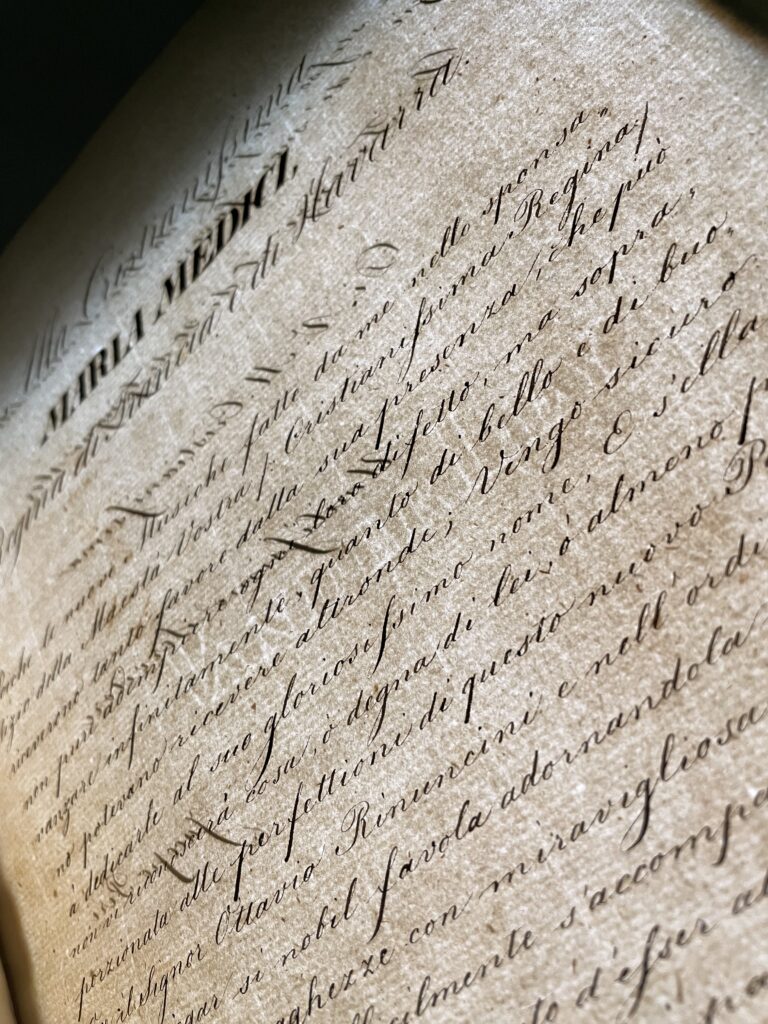
The opera is comprised of five scenes in two acts with an accompanying prologue. Both the music and libretto were dedicated to Maria Medici, of the wealthy and powerful Medici family of Florence, Italy (Peri’s hometown). Maria was to be married that year to Henry IV of France, and the entirety of the musical material of the opera is dedicated to Medici, with an additional author’s note written by Peri (translated from our manuscript copy using DeepL Translator).
…Accept from me, Your Majesty, as noble and worthy—not from anything other than the greatness of Your Majesty itself, which has honored me—And please accept, in addition, the affection of my long-standing service, which I dedicate to you once more—both in person and through this music—and I pray to God for the fullness of blessings, graces, and favors upon you. On the 20th of February 1608, to Your Most Christian Majesty, your Most Humble Servant, Jacopo Peri.
The book had been in the collection for decades, if not longer, but little was known about it.
Where did it come from?
And more importantly…
How did it enter our collections?
I immediately set to learning the answers to these questions, but when I asked my supervisor, Miriam Intrator, they confessed that they knew as much as me about the materials and the acquisition, which is to say that very little was known about it.
We set out checking the places where we might find answers, but the library website entry provided little more than what we already knew about the book, and the original catalog card for the book was undated. We therefore could not be at all certain of the acquisition of this item; I encountered the first of many dead ends when trying to investigate this item.
So, what did we know?
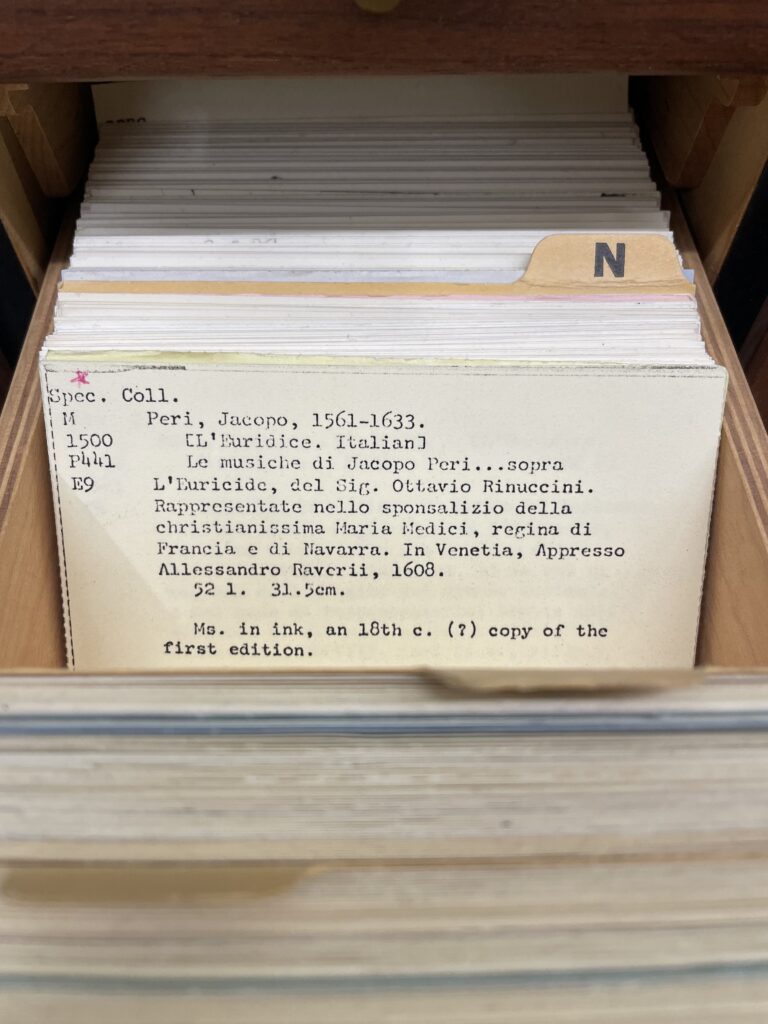
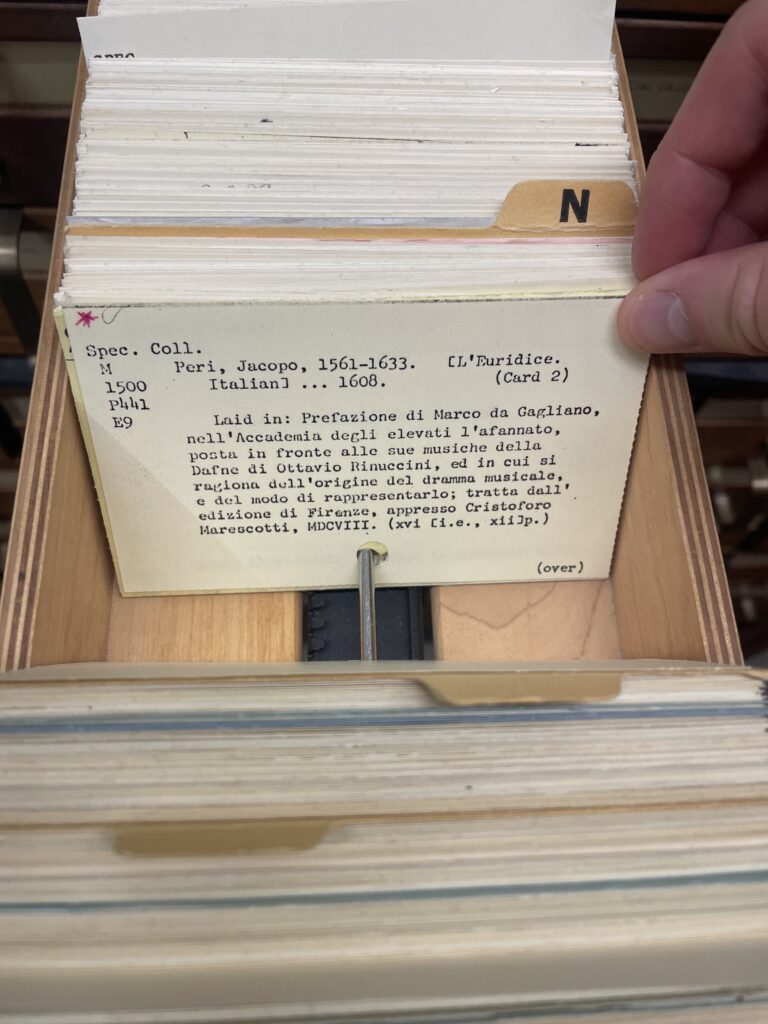
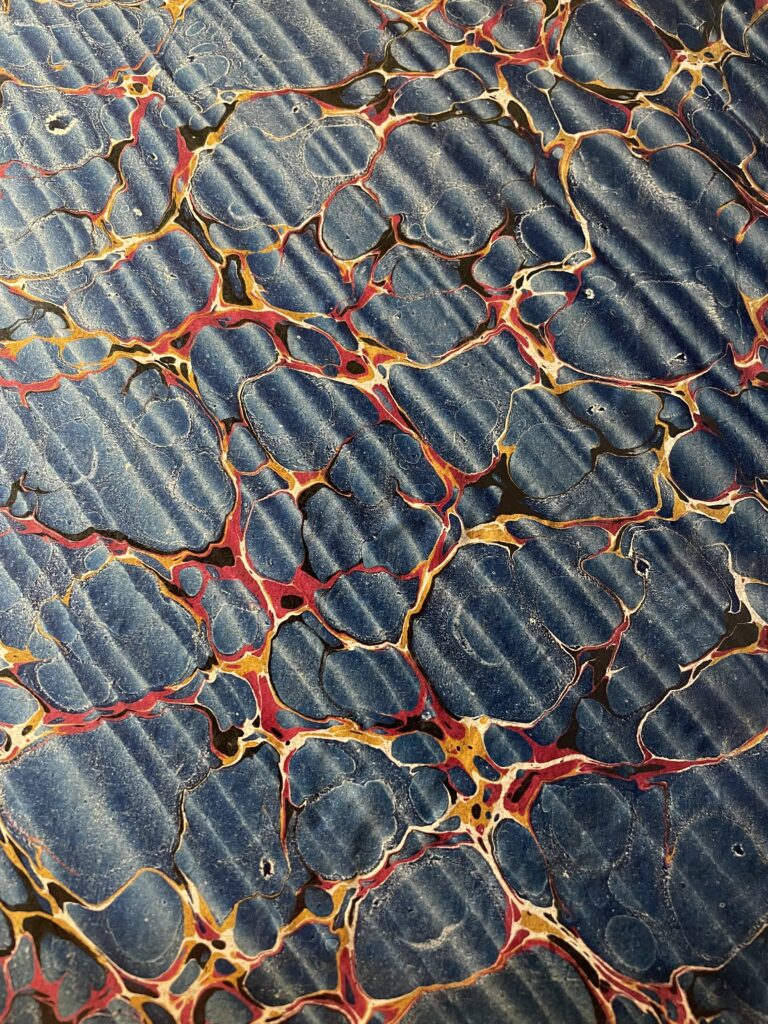
We’re aware of the musical material itself, that being Peri’s L’Euridice, and that this must not be an original copy from the seventeenth century (the piece premiered in 1600), but a later, likely late 18th to early 19th century copy of the original manuscript. Hints include the wove paper on which the music has been copied, as well as the blind tooled full calf binding. The front and back endpapers are marbled as well.
Inserted into the book was a small pamphlet in Italian which looked like it didn’t belong to the same period as the manuscript, but the pamphlet happens to mention the opera within it. Translating the pamphlet, though, it seemed to resemble little relation to the actual manuscript itself and provides little in the way of where this exact copy came from. On the front few pages, particularly on the paper in which Peri writes his dedication to Maria Medici, there is a faint watermark with some identifiable lettering, but the full marking cannot be deciphered; the producer of the paper thus also remains a mystery.
Every new lead led to more questions, and many details pertaining to both the acquisition of the object and the object itself remain a mystery to me.
How then, as archivists, historians, researchers, can we come to terms with the absence of a historical record in our collections?
Archives and special collections serve an inherently historical purpose, and they are inherently incomplete. Not everything can, or should, be kept. Yet they exist as repositories of information and preserve accounts of various people, places, and things. Histories of both the living and the nonliving are contained within collections, and even though some objects which occupy space in the collections are not direct works of history, all items can be considered ‘historical artifacts,’ objects on which we place historical emphasis, based on criterion and characteristics such as the rarity of the item, its age, the creator, the historical significance, among many other factors.
To the student of any discipline, academic or otherwise, questions without answers can initially be uncomfortable, and for some, even frustrating. Humans often comfort themselves with answers, even if those answers deal with speculation of the unknown. History as a discipline is laden with gaps in historical knowledge, so much so that one can consider the unknown as characteristic to the field of history. Altogether, the historical record leaves more questions than answers; there is more unknown than there is known. Historians often assume theories that take on speculation and abstraction in order to connect separate historical concepts into cohesive historical narratives. It is in this practice that many historians must learn to deal with and be honest and transparent about the unknown.
Over the course of trying to research the provenance of this manuscript, I soon learned not to be discouraged by my inability to uncover more from the item I studied. Objects such as this enter collections all the time and stay for years, only to be (re)discovered and potentially better understood years or decades later. History is not satisfying, nor is it definitive. It is unsatisfying, uncomfortable, multifaceted, malleable, ever-changing, and endlessly complex. Time erodes answers and obscures truth, and it is our job as academics to acknowledge the component of the unknown to the study of history.
Watermark Finding Update
After completing this post, I made a breakthrough discovery on some of the information associated with the item! While I was using a light sheet to photograph the watermark, I spontaneously decided to try turning off the overhead lights in the room. To my surprise, the increased darkness allowed me to discern the full watermarks on the first few pages of the book!
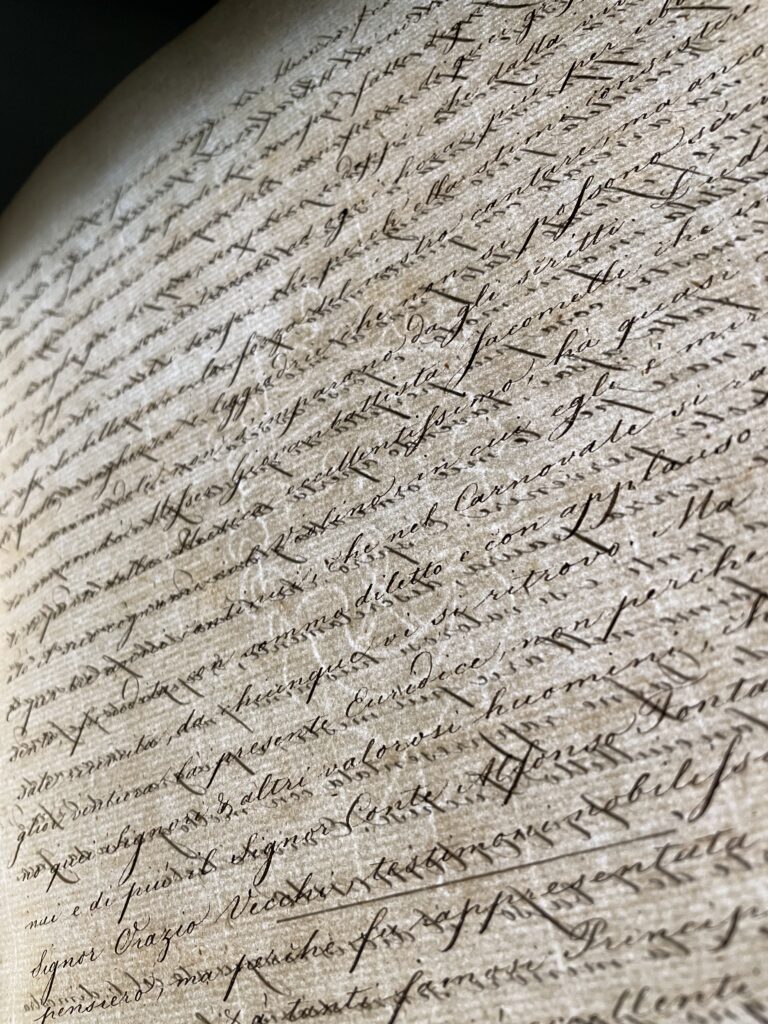
The watermark on the left reads “Vanderlay,” which after a short search led me to the name “Van Der Lay,” a family of famous papermakers in the 17th-century Dutch Republic (modern-day Netherlands). Pieter van der Ley opened the first family mill in Zaandyk (in Holland) in 1665 [2]. The family business ended around 1815 [3]. The watermark on the right appears to depict a coat of arms with a crown on top. A full engraving of the watermark closest to this one in the Peri opera book, but not an exact match, can be seen on page 252 of Watermarks in Paper: In Holland, England, France, ETC., in the XVII and XVIII Centuries and Their Interconnection (W.A. Churchill) [4]. This is a fantastic addition to our knowledge of and speculations about this L’Euridice manuscript, but there still remains much to be answered.
Further Exploration
Listen via YouTube to an audio recording of the original version of L’Euridice, performed by students and guests of the University of Illinois. Performed on October 6, 2000, the four-hundred-year anniversary of the opera.
Endnotes
[1] According to Frederick W. Sternfeld, the plot of the Orpheus myth allowed as an artistic springboard for operas from composers such as Gluck, Offenbach, and even Stravinsky. The myth was therefore continuously set by composers even into the twentieth century, a testament to the longevity of the story and its enduring effect on music.
[2] Churchill, Watermarks in Paper (Menno Hertzberger & Co., 1935), 9.
[3] Ibid., 16.
[4] Ibid., 252.
Works Cited
Sternfeld, Frederick W. “Orpheus, Ovid, and Opera.” Journal of the Royal Music Association 113, no. 2 (1988): 172-202.
Churchill, W.A. Watermarks In Paper: In Holland, England, France, ETC., in the XVII and XVIII Centuries and Their Interconnection. Menno Hertzberger & Co., 1935. https://dn721906.ca.archive.org/0/items/b31345736/b31345736.pdf.