By Ava Turner, ’28, Anthropology and Geography, University Archives spring semester intern
At the start of this spring semester, I was tasked with processing a box of records regarding the campus Greek organization Kappa Delta Pi. Prior to embarking into this process, I had absolutely no knowledge as to what Kappa Delta Pi was, incorrectly assuming it to be a campus sorority. I also had what I thought to be minimal knowledge as to how to process a collection such as this one. These two facts resulted in a feeling of slight fear and unpreparedness within me, and I did not believe that I had the knowledge or skill set to complete the task of processing this collection.
What is Kappa Delta Pi?
Kappa Delta Pi is a National Honors society for both current scholars and educators, working to assist and educate those seeking careers in the educational field. The Ohio University Chapter of this organization, or Omega Chapter, has a rich history of importance for this national organization, both attending and hosting notable events.
What Does This Collection Hold?
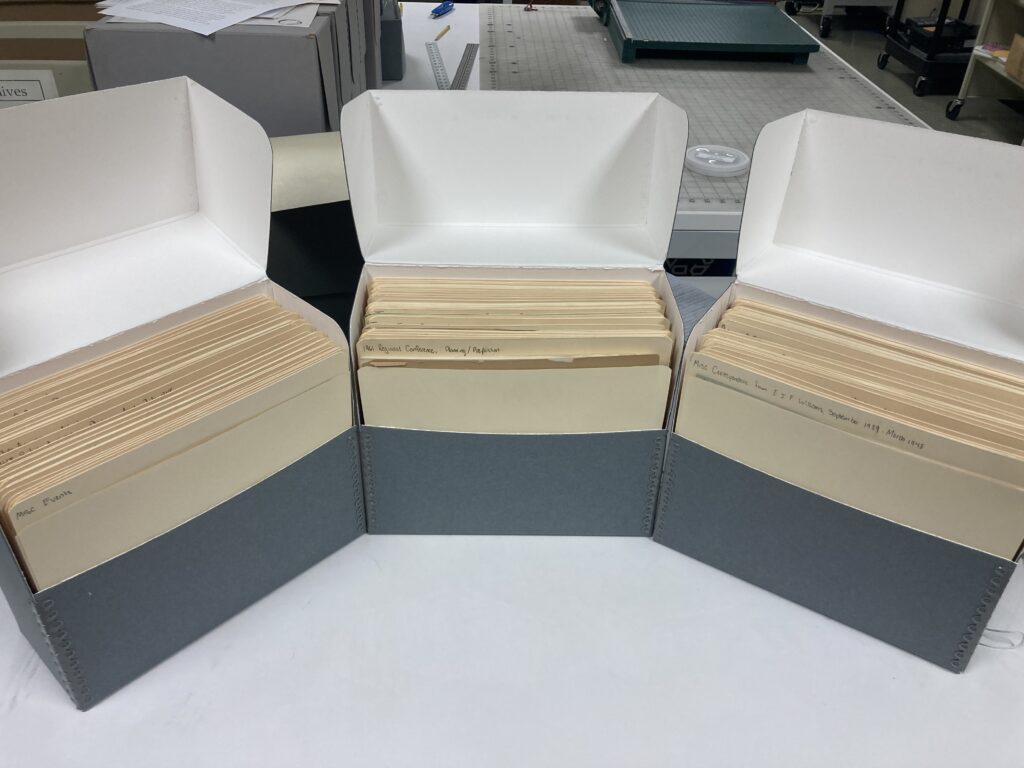
The Kappa Delta Pi collection contains a total of eighty-six folders, which have been organized into nine distinct series: Events, Correspondence, Scholarships, Information and Laws, Reports and Records, Membership, Meetings, Publications and Publicity, and Miscellaneous.
Series 1: Events
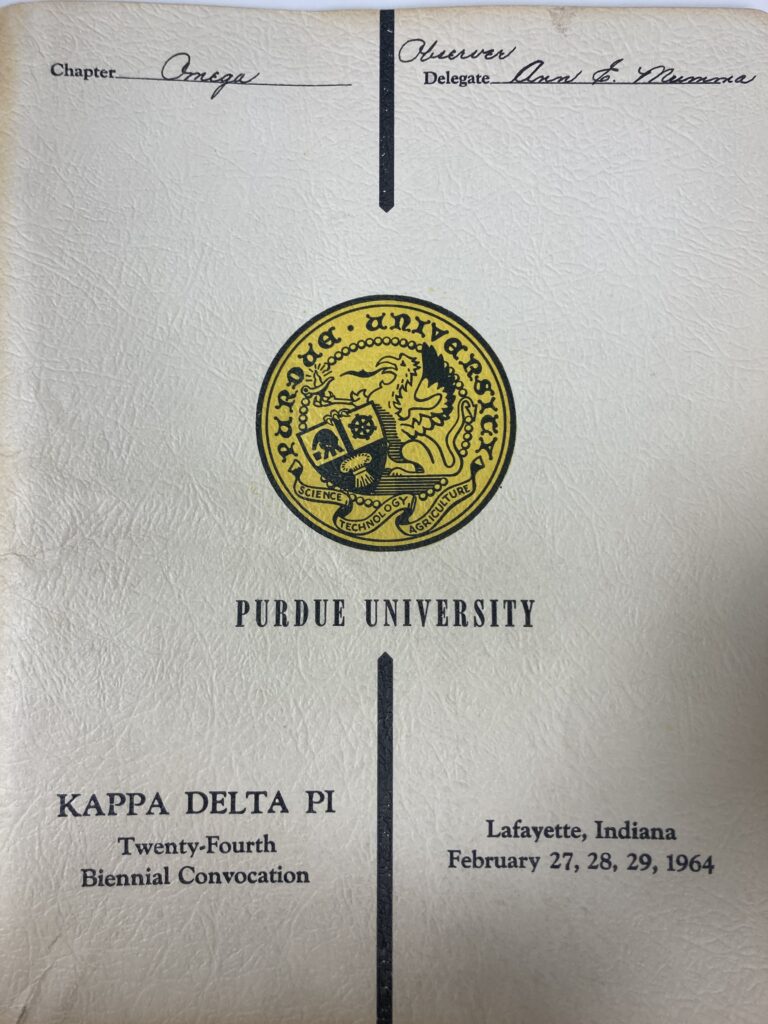
This series contains documents regarding events that were planned and/or attended by Omega Chapter members, spanning from a 1924 Convocation in Chicago to the Twenty-Fifth Biennial Convocation of 1966 in Houston. These convocations are quite prominent throughout this series, as they were large-scale national events that occurred roughly every two years, with some notable gaps in its occurrence, or, at least, in the collection’s contents related to the events. These events allowed for various chapters of Kappa Delta Pi across the country to come together and discuss prominent issues and inform themselves on the happenings of the organization. Other major events existing in this series are regional conferences, two of which were hosted by the Omega Chapter at Ohio University, in 1957 and 1961. These two events compose a wide selection of the documents and folders, containing information about the planning, attendance, event agendas, and correspondence. Despite the bulk of this series relating to these large-scaled events, the series also contains smaller events such as a luncheon, band concerts, and even a rummage sale.
Series 2: Correspondence
The correspondence contained in this series stretches from 1938 to 1967. Much of the correspondence in this series was sent either to or from Ann E. Mumma, the counselor of Omega Chapter and a prominent figure throughout the whole collection. Much of Mumma’s correspondence is about initiations, chapter and national-level dues, jewelry and badge orders, various events she planned or attended, and the creation of the McCracken Scholarship Fund. The other most prominent figure throughout this series is Dr. E.I.F. Williams, the Recorder-Treasurer of the Executive Council of Kappa Delta Pi. Much of Dr. Williams’ correspondence is between him and Ms. Mumma regarding financial matters and events. This series, however, also contains correspondence to and from a wide variety of additional individuals, including chapter presidents, Laureate Council members, and treasurers of Kappa Delta Pi.
Series 3: Scholarships
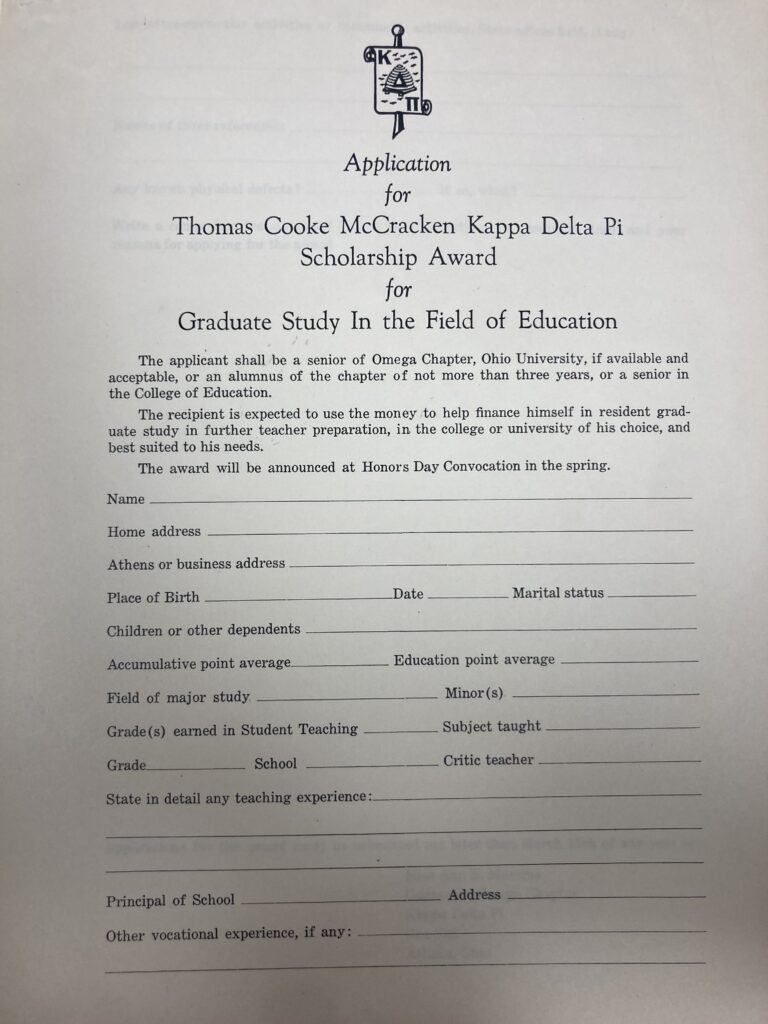
Most of this short series holds records relating to the Thomas Cooke McCracken Scholarship, a Kappa Delta Pi Scholarship made to honor Dr. McCracken, who was a prominent figure at Ohio University, as well as a Laureate Member of Kappa Delta Pi. This scholarship was established in 1948, and continues throughout 1954, the latest document in the collection. This collection also holds briefer information about the 1956-57 International Education scholarship.
Series 4: Information and Laws
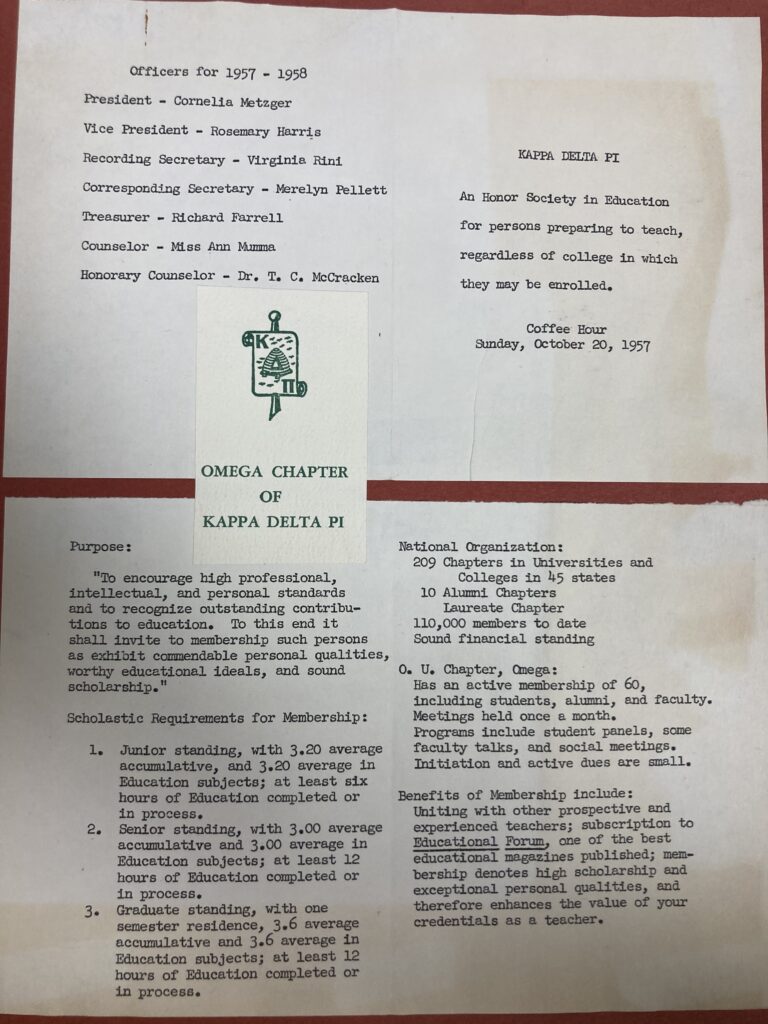
This series contains an assortment of documents relating to information about Kappa Delta Pi, targeted towards prospective student members, and individuals who have been recently initiated. This series also contains various official KDP documents, including information about The Honor Key, Parliamentary Law, By-Laws, and Ritual. This information stretched from 1947, with a circular of information for initiates, to 1966, with a notice to interested students.
Series 5: Reports and Records
Another short series, comprising only three folders. Despite that, this series holds much valuable information starting in 1945 and ending in 1967, containing financial reports of treasurers and records of receipts of expenditures, showing how and when Kappa Delta Pi earned and spent money. This series also contains annual reports, discussing the officers, membership, and activities that occurred within a specific academic year.
Series 6: Membership
This series is composed of an assortment of lists of members who were either active members of Kappa Delta Pi (Roll and Meeting Attendance) or were seeking membership (Candidates for Initiation and Initiates). Rosters of individuals begin in 1923 and continue throughout 1958. This series also contains a folder with information on dues, specifically noting who had paid their dues and who still needed to do so.
Series 7: Meetings
This series dates from 1945, with a yearly program, to 1968, with an informational poster about an upcoming meeting. Interestingly, this poster is the latest document throughout the whole collection. This short series contains information about meetings conducted by Kappa Delta Pi, including yearly programs depicting what that academic year would look like for the organization, various meeting notices informing members of the organization about an upcoming meeting, and meeting minutes.
Series 8: Publications and Publicity
This series holds a multitude of publications either by or about Kappa Delta Pi. This includes two publications by Kappa Delta Pi: The Omegan, a publication by the Omega Chapter, and The Educational Forum, a national publication created by the organization. This series also includes Ohio University-specific publications, including original press releases, orders for pages in the Athena, and various newspaper clippings holding information about Kappa Delta Pi and their events.
Series 9: Miscellaneous
The final series of this collection is a miscellaneous one containing two folders. The first folder is for Burr, Patterson & Auld Co., with information relating to the company which Kappa Delta Pi worked with for jewelry and pin orders/manufacturing. The final folder is miscellaneous, with records that I was unable to relate to other materials within the collection.
The Processing Process
My first step in this task of processing was to inventory the contents of the collection. Upon my initial look, I observed that the collection was disorganized. Although some of the folders appeared to be accurately labelled and contained papers of related topics, the papers were nonetheless unarranged in any discernable order despite their common themes. Meanwhile, other folders were completely disorganized with unrelated documents having been randomly thrown together within the same folders. While completing my initial inventory of the collection, I made sure to make specific notes about how I would approach rearranging the collection so that the folders and the contents within them made rational sense to me and to the future researchers.
Next, I began to create my own folders, organizing and placing many of the documents into new folders. This was a lengthy process, as I wanted to have specific and easy-to-understand folders, while also having a place for each record in my collection. This entire process resulted in creating a total of eighty-six unique folders for the collection.
Once I had all the records organized into folders, there was still much organization to be done. Firstly, I had to go back through each individual folder, reorganizing the documents in an orderly manner, to make the contents of the folders coherent. Most of this was done by chronologically organizing the documents from oldest to most recent, to allow the papers in each folder to demonstrate a linear, rational path of progression. Then, I had to organize the folders, to create similar groupings as well as order within those groupings. Once again, in this process, I prioritized ordering based on chronology to create an easy-to-follow path. However, I did choose to order the correspondence folders alphabetically, with dates as a secondary organization, to make it easy to find documents related to specific individuals within this series/collection.
After completing all the processing for the collection, I then set off to create a second inventory of the collection, this time based off the organization I had created. With this order and inventory, I created my finding guide including summaries of the contents of each individual folder, allowing for future researchers to know in advance what exists in each folder. Seeing my collection laid out in this manner caused me, once again, to do some touch-up re-organization; I changed the order of some of the folders to keep similar themes together.
Over the course of the semester, I proved myself to be a fool in one main regard: the idea that I would be unable to complete this task of processing the Kappa Delta Pi collection. While I certainly faced some minor hardships along the way, I showed to myself and those around me that I could make a coherent collection.
Collection Link