By Hayden Sprance, English Literature, Culture, and Writing BA ‘26, History minor, Museum Studies certificate. Fall ‘25 Manuscripts Intern under Manuscripts Archivist, Greta Suiter.
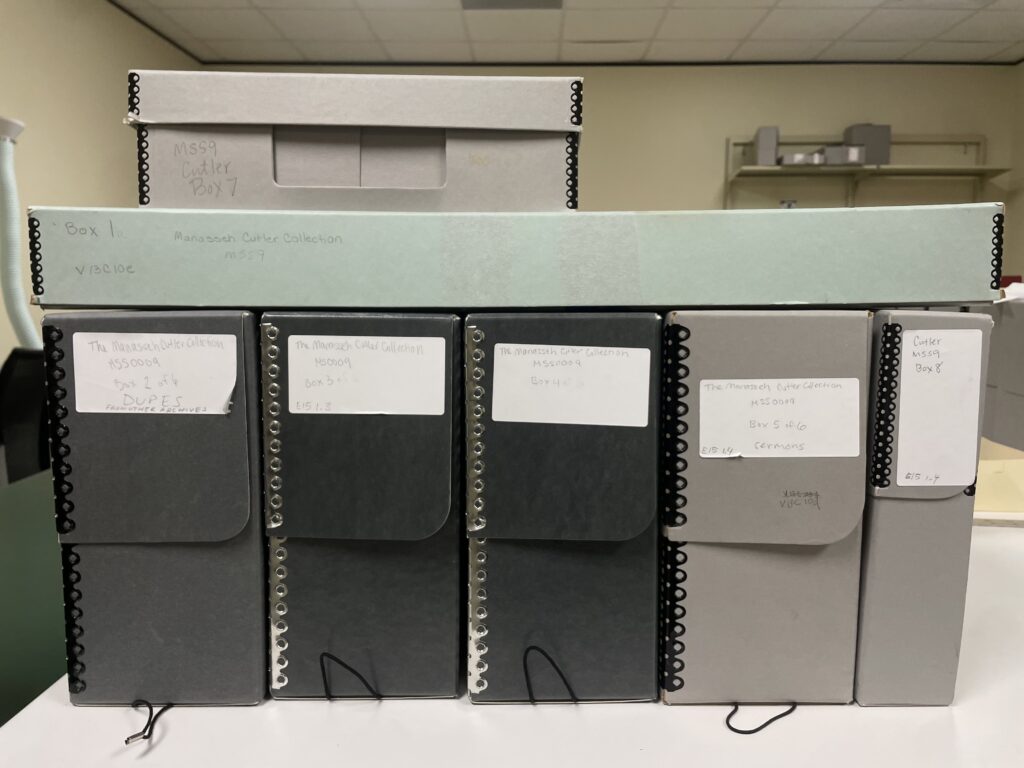
When I began my internship in the Mahn Center this past August I was nervous… like, really nervous. When I learned I would be assigned to the Manasseh Cutler Papers containing material from 1761-1849, I felt disoriented and fully out of my element. I hadn’t studied this period of history in depth quite honestly since the 9th grade…unless we’re counting listening to the hit Broadway musical Hamilton for hours on end. As a senior English/history student I worried I wouldn’t be able to connect with a puritanical Federalist and botanist. As I quickly approach the end of my time as an intern, I’ve found that we’re really not much different from each other.
My primary task throughout my internship was to search for themes of westward expansion, slavery, indigenous populations, and religious and educational values, alongside identifying key people, places, and dates. This led me to become very acquainted with not just Cutler’s resume of achievements, but also his humanity.
Who Was Manasseh Cutler?
Manasseh Cutler is a name you may only know from walking around College Green, or maybe you’re in the Cutler Scholar’s Program here at OU – an honors program which is intended to prepare undergraduate scholars to civilly debate and think critically about social issues while also giving them the opportunity and funding to relate these skills to the broader world. Regardless, Cutler’s legacy isn’t the only thing impressive about him. In his time, he was a skilled and highly educated botanist, reverend, and politician. He fervently supported American independence and was a true renaissance man who was a proud member of various academies and societies which promoted his botanical research and grew his network of both political and scientific colleagues including well-known names like Benjamin Franklin.
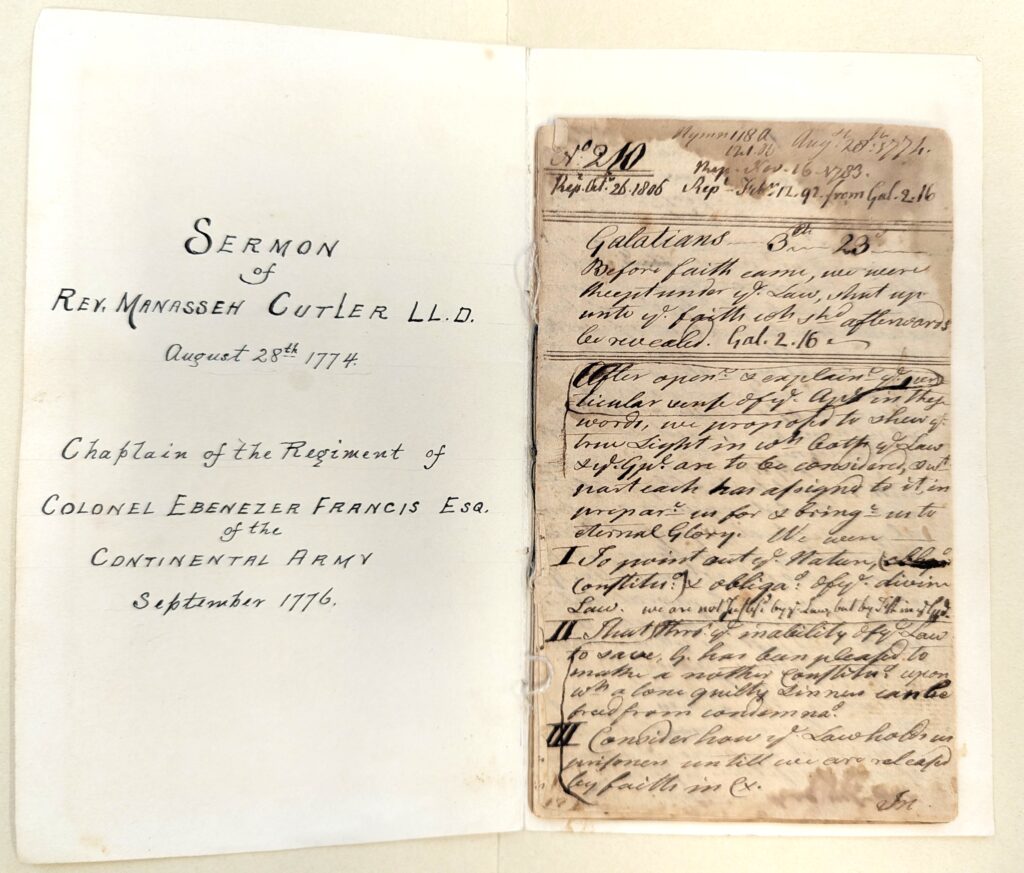
Cutler began to study divinity in 1768 and was an ordained minister of the Congregational church from 1771 until his death. As noted, Cutler served as a chaplain in the Continental Army in both 1776 and 1778 during the American Revolutionary War.
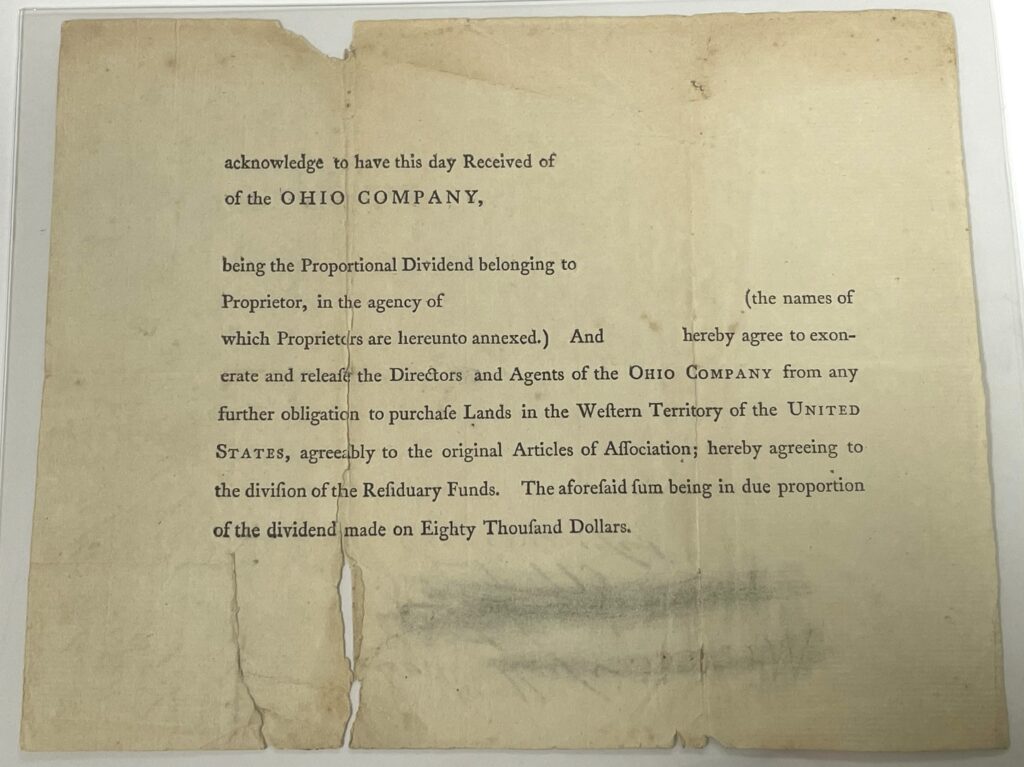
Most notable to those of us in Athens, Cutler is remembered as “The Founder of Ohio University”. Cutler used his political strength to lobby for the Congress of Confederation, making it possible by passing the Ordinance of 1787 which created the Northwest Territory (which was previously ceded to the United States in the Treaty of Paris in 1783). Cutler worked to co-found the Ohio Company of Associates in 1786, which helped to not just purchase land in the Northwest Territory, but also acquire a land grant from Congress to establish a university in this area, thus eventually leading to the founding of Ohio University in 1804.
Working in the Cutler Papers: Education and Government in New Lands
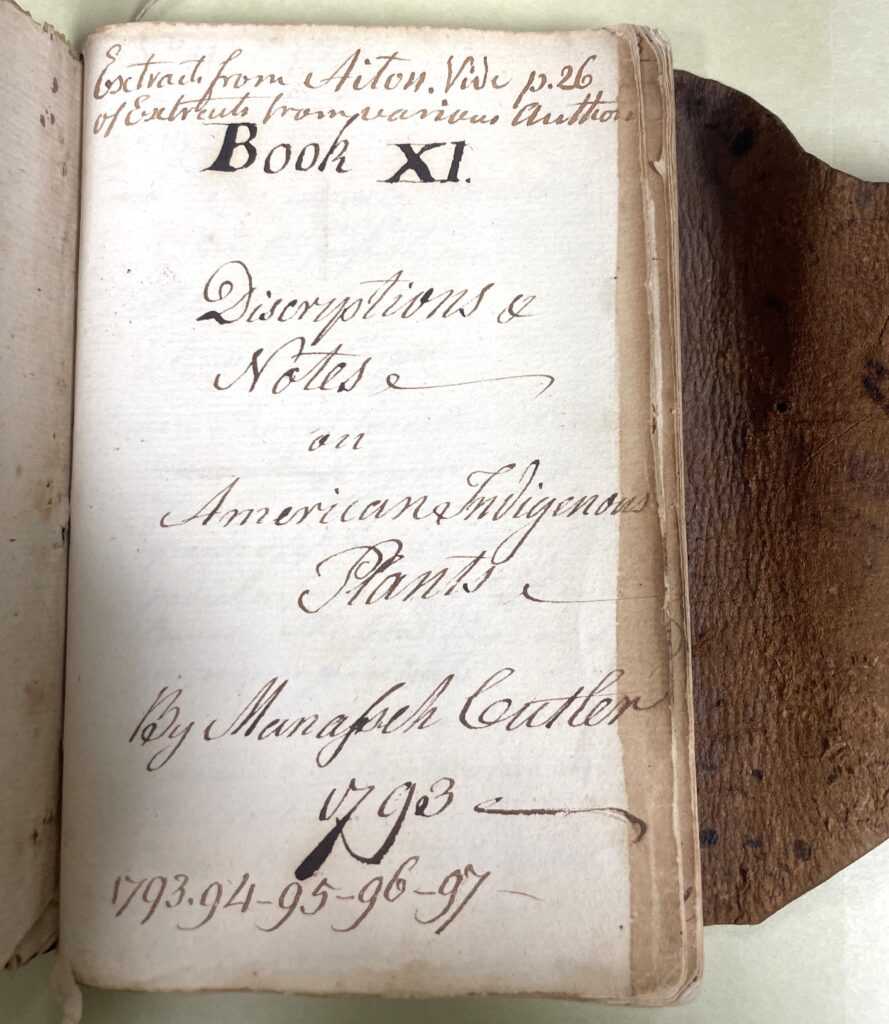
While much of the Cutler papers includes his own botanical research (ask me how many scientific plant names I’ve learned in the last 13 weeks!) or long sermons preached to his home church, sprinkled between conversations of indigenous plants and herbal treatments for disease, Cutler inexplicably lays out a foundation for a new beginning. Full of hope for future educated generations as well as abolition in the newly established territory, Cutler’s drive prompted change during a polarized world that I think in some ways, reflects our present society.
I began my first few weeks in this collection voraciously poring over each box, and more intensely, each piece of correspondence. I found that much of the material was made up of various letters both to and from Cutler regarding his botanical research (and on some occasions there were mentions of zoology, ornithography, meteorology, and astronomy). Other pieces of correspondence were more centered around vague political matters, only able to be pieced together when carefully analyzed against broader historical contexts. While looking out for information on the Ohio Company, I stumbled across an interesting letter from Cutler to Jonathan Stokes, a scientific colleague, dated in May 1805. While discussing the current political state at the time, Cutler dives into what he perceives to be the largest threat to liberty and free government: the rapid progression towards a despotic government. Following this paragraph, I have included some engaging quotes from Cutler in this letter, and I invite you to reflect on them for a moment. Consider the division in the United States during the period directly following the Revolutionary War, as well as Cutler’s perspective as a politician and reverend taking charge into new lands.
- “The democratic notions which have so unfortunately divided the people in this country, and led them off from the true federal principles, (the only principles on which a free government can exist).”
- “We are progressing rapidly to a despotic government, & the democratic Mr. Jefferson will probably be our first Emperor.”
- “The plant of freedom is withering in this country & ye ‘Crown imperial’ will occupy ye ground.”
Approaching Educational Reform; Establishing Ohio University as We Know It
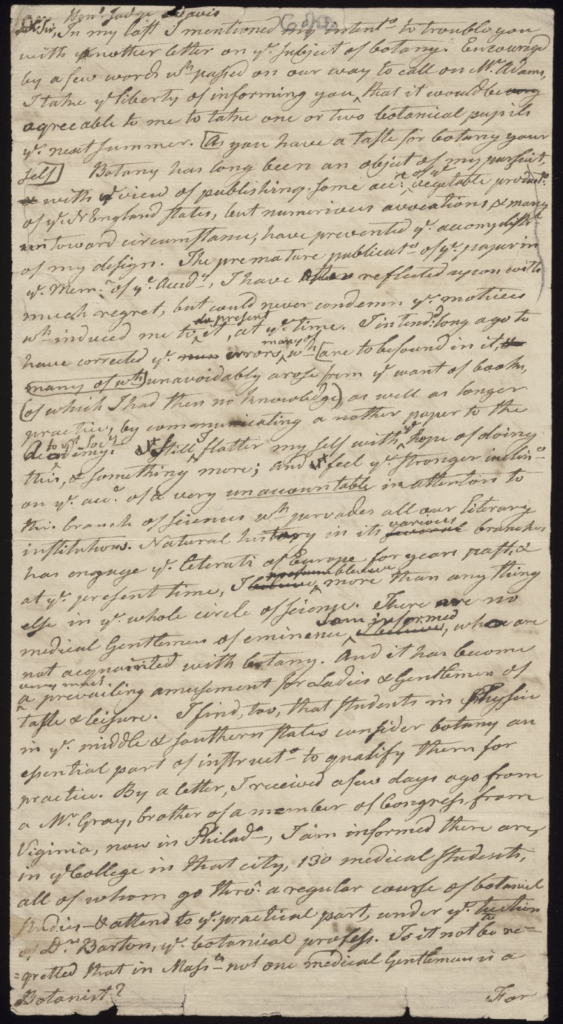
Cutler was an educated man himself, graduating from Yale College with high honors, and going on to study law. He saw the value of a well-rounded education and wanted as many people to have similar opportunities as he did. Cutler was also concerned with the future of education. For one, he felt alarmed at the neglect of the subject of natural history (primarily botany) within literary and medical institutions in the United States. He writes that a published botanical paper was meant to “convince my country-men, among whom this science has been much neglected, that botanical inquiries are not useless speculations…” Cutler himself even took up the opportunity to take on a very small amount of pupils to study below him, and envisioned a structured, rigorous, and long-term process that he outlines to Judge John Davis in which his students “…may acquire all the instructions necessary for performing the studies by them selves– and for practical purposes…” In this same letter, Cutler aims to set his students up for success by connecting them with his international colleagues via mail correspondence and saw this as a direct pedagogical advantage for his students over the passive and noncompetitive educational system during this period.
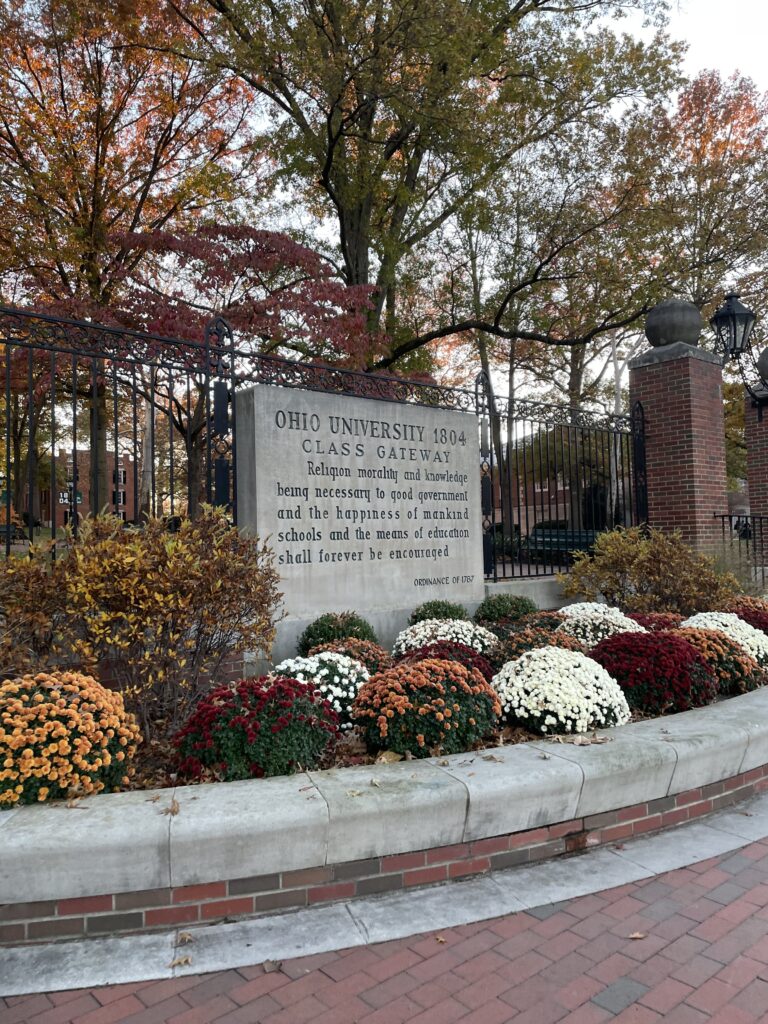
The Northwest Ordinance sought to set land aside for public schools, and desired to establish a precedent for the support of higher education in these new territories. The Northwest Ordinance of 1787 mandated that in the lands of the Northwest Territory, “schools and the means of education shall forever be encouraged”–you may have seen this quote in full at the Class Gateway in College Green. Cutler took a lead in drafting the ordinance, and it was presented to Congress by Massachusetts delegate Nathan Dane. In 1797, settlers from Marietta (the first Ohio settlement) traveled upstream through the Hocking River to establish a location for a university and chose the region of Athens due to its location between Chillicothe and Marietta. After Ohio officially became a state in 1803, the Ohio General Assembly officially established Ohio University in 1804, and its first three students enrolled in 1809.
Cutler saw education as an active contribution to knowledge and a prerequisite for personal excellence and aimed to resolve the present failings of the educational system especially regarding the subject of natural history. I cannot call myself a scientist by any means, but I can certainly understand the dissatisfaction with the reality of public education. As I begin to apply to graduate schools, I find myself reflecting more each day on the opportunities and experiences that I have been fortunate enough to take advantage of— all of which began as a result of Cutler’s work in passing the Northwest Ordinance and establishing a university in Athens, Ohio.
Now that the semester has almost found its end, and my work is just about done in this collection, I can say with confidence that Manasseh Cutler and I really aren’t too different from each other. Cutler was driven, passionate, and set forth change in every area he saw as depleted.
I don’t think Cutler could have ever predicted that a 21-year-old girl like me would find so much humanity in his work, but I will forever be indebted to this internship for allowing me to critically think and reflect on the lasting successes of his accomplishments only achieved through his personal enthusiasm. As I exit the Mahn Center each Tuesday and Thursday I look up at the back of Cutler Hall, take a moment to listen to the Westminster Quarters chime out, and reflect on the legacy Cutler has left on OU’s campus 221 years later. Cutler’s personal achievements as a politician and reverend may be more well known to the general public, but I will always remember him for his devotion to change and forthrightness to make his growth in education and government happen.
Accessing the Collection
As 2026 and the 250th anniversary of the American Revolution approaches, the archives is preparing an exhibit featuring the Cutler collection that will open in Alden Library in the fall of 2026. To access the Cutler collection please see the collection description and the digital archives for items that have been digitized. For more information about the archives including how to make an appointment to view anything from the collection please see this website.