By Luke Homan, Classics and Religious Studies, and Anthropology ’28, Fall 2026 Manuscripts Intern
Within a series of letters purchased for the small price of twenty-five dollars by a professor of English Literature by the name Harlan W. Hamilton, lies the story of a woman who faced the unilateral scathing attention of the British aristocracy and emerged unbowed. While Duchess Elizabeth Chudleigh was by no means a hidden historical figure, with a book being written about her life in 2022 by Catherine Ostler titled The Duchess Countess, it is through the archival collection that I was able to learn about this notable woman. Chudleigh’s preserved correspondence provides a fascinating glimpse into the life of a Georgian aristocrat.
Images and letter from The Harlan W. Hamilton collection of correspondence unless otherwise stated.
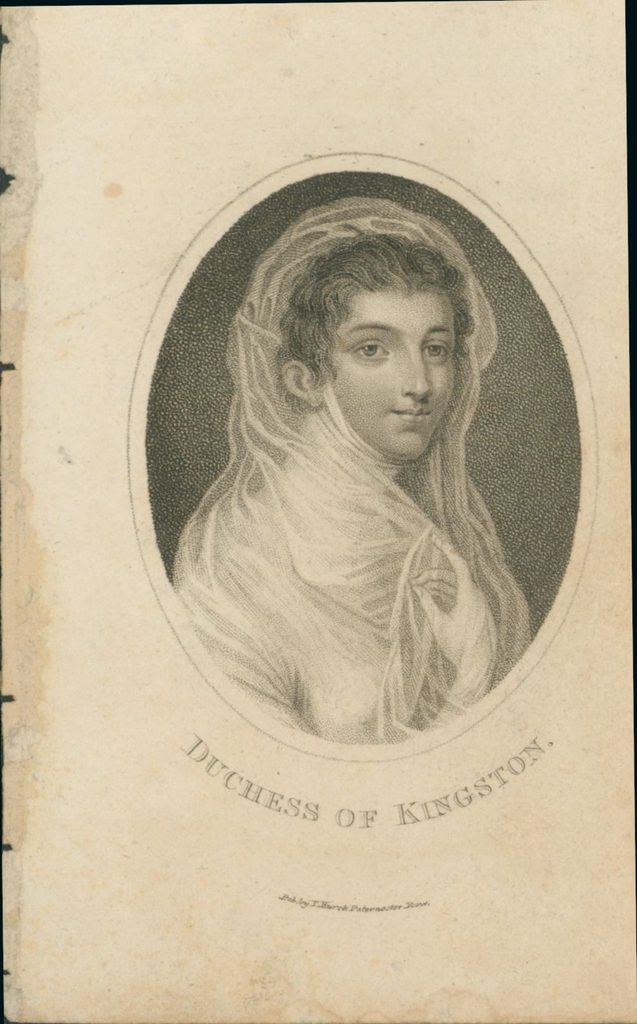
Elizabeth Chudleigh was born 8 March 1721, to Colonel Thomas Chudleigh and Henrietta, his first cousin. They were a family of no great means; Thomas’ elder brother received much of the family’s fortune. The proud Thomas Chudleigh fought in the army and was the proprietor of the Royal Hospital in Chelsea. As Elizabeth Chudleigh grew, coming into her 6th birthday, her father sadly died of a cold. The small family consisting of Elizabeth, her elder brother Thomas, and their mother found themself moving into a rented home in London’s Mayfair. What little money the family had was funneled into the high-end education of Thomas (he passed prematurely at the age of 20 in service of the military). (1) This left Elizabeth with few options, and as an enterprising young aristocratic woman, she knew she had to find a wealthy husband.
(Portrait of Elizabeth Chudleigh featuring the young woman wrapped in a shawl. – Holme Pierrepont Hall)
At the age of 22, she secured a position as maid of honor to Princess Augusta, wife of the Prince of Wales. A position whose duties largely consisted of being interesting, beautiful, and most importantly, single. Unfortunately for her continued employment, just that year, Chudleigh met the charming and handsome 20-year-old Augustus Hervey. A man deemed the “English Casanova” and employed as a Royal Navy officer of some renown, not to mention the grandson of the Earl of Bristol. In a secret candle-lit ceremony held in a diminutive chapel located on the grounds of the country estate of Chudleigh’s aunt, the two were wed. But soon after, the young lovers parted ways and did not see each other for two years.
Chudleigh needed to maintain her public status of being unwed, lest she lose the position as maid of honor, and more importantly the small salary of £200 that came with it. She was a consummate performer, melodramatic at the best of times and prone to public fainting spells. At a masquerade ball attended by King George II, in costume as the mythical Iphigenia, Chudleigh was nearly topless. Although the outfit was supposedly enjoyed by the monarch, it was less appreciated by the fellow maids who reportedly refused to speak with her for the night. (2) The costume was so notorious that penny prints of the night were still produced nearly a century after its scandalous debut.

Augustus Hervey returned to England in 1747, appalled at the audacious and flirtatious reputation that Chudleigh had gained while he was away. He threatened to go public with their marriage unless she met him privately. Upon appearing for the meeting, he locked her in his apartment and forced himself on her. Chudleigh became pregnant, having the child in secret. The infant passed soon after, at the age of three months. Hervey and Chudleigh separated soon after, although not legally filing for divorce. (3)
In the year 1750, Chudleigh met the famed Evelyn Pierrepont, Duke of Kingston. The two fell in love, but he knew of her illicit marriage, so he postponed proposing to her. The relationship was practically an open secret as the extremely wealthy Evelyn showered Chudleigh with gifts and favors. However, nearly 20 years later, in 1769, Augustus Hervey appeared, asking for a divorce. (3) Elizabeth wanted to avoid a scandal, therefore, with the collusion of Hervey she filed for jactitation. An archaic cause of action in English law where one party insists on the presence of a marriage that did not occur and the offended party files for the ceasing of the ascertained false marriage. After Hervey failed to provide evidence of their matrimony and as Chudleigh swore she was unmarried, she was filed as a spinster and free to marry. (1) After many long years of waiting and open secrets, within the month, Chudleigh was wed to Evelyn Pierrepont, Duke of Kingston, becoming Elizabeth Pierrepont, Duchess of Kingston-Upon-Hull.
Sadly, Kingston passed in 1773 after only 4 short years of marriage. He willed the vast majority of his wealth and possessions to her on the condition she remained unwed. This angered the late Duke’s family and in 1775, incited the nephew of Kingston, Evelyn Meadows to file a charge of bigamy against Chudleigh. The traditional punishment of which was the burning of the offender’s hand. Instead of settling, Chudleigh chose to stand public trial under her right as aristocracy to be tried as peeress. (1) Due to her poor health, she narrowly avoided a stay in the infamous Tower of London. She pled her case with ardor, although sickly and escorted before 116 of her “peers”, an assembly made up entirely by men, by two attendants in white, a chaplain, a physician, an apothecary, and a constable. (2)
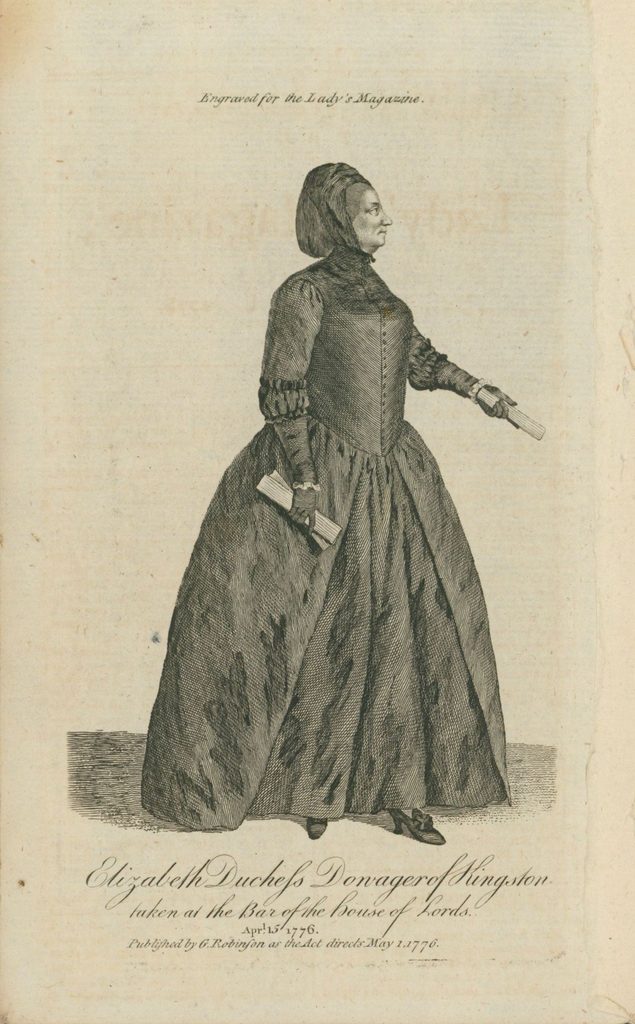
The trial was a sensation, it lasted 5 days and the courthouse was so packed that it was supposed an onlooker fell into the road and was killed by a passing cart. The impending Revolutionary War of 1776 and her trial battled for the headlines, and Chudleigh slinked out of aristocratic gossip circles. (3) Despite her impassioned defense, Chudleigh was found guilty of bigamy, her prior annulment invalidated, and the Duchess stripped of her titles, name, and marriage to her late second husband. (1) The humiliation and public ordeal of the trial deemed sufficient punishment, so the burning of her hand was forgone.
(Elizabeth Duchess Dowager of Kingston taken at the Bar of the house of Lords. April 15, 1776. Published by G. Robinson as the Act directs May 1, 1776. Elizabeth testifying to her innocence before a court of her “peers”, this image features the middle-aged woman dressed head to toe in a black dress and bonnet.)
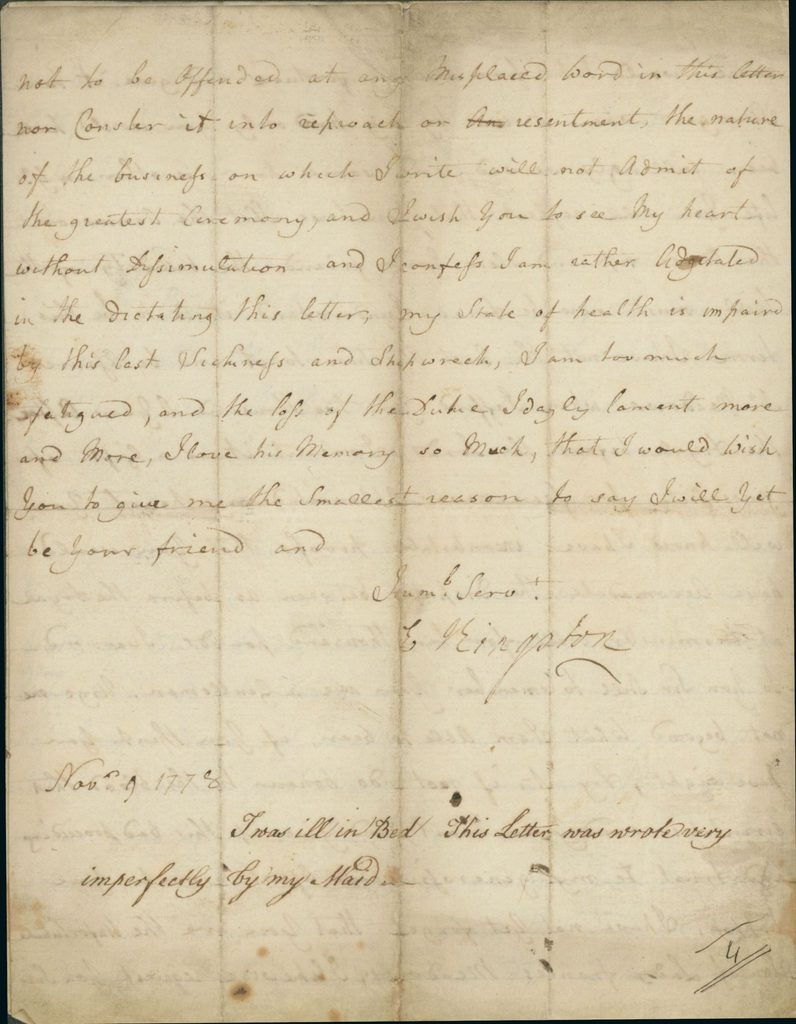
She did not fade from public eye or history after this humiliation, absconding with her late husband’s wealth to the city of Calais in France. Chudleigh later wrote to Evelyn Meadows about the cause of the suit of bigamy against her, stating that she remained a woman undaunted and unbroken. I read a letter penned by a maid after their arrival in Calais, at the time Chudleigh had fallen ill after the long overseas travel and stressful past few months. She does not apologize and does not pretend to hold any regrets for her torrid relationship with her beloved late husband. Chudleigh only wishes that she may still retain a friend in Evelyn Meadows.
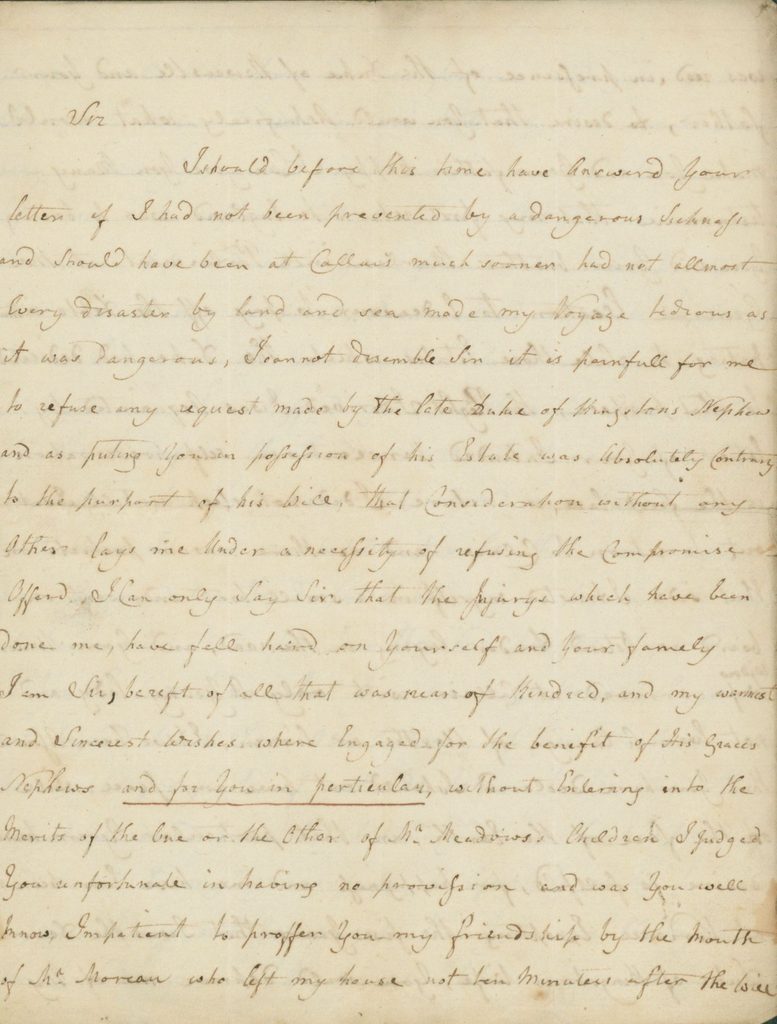
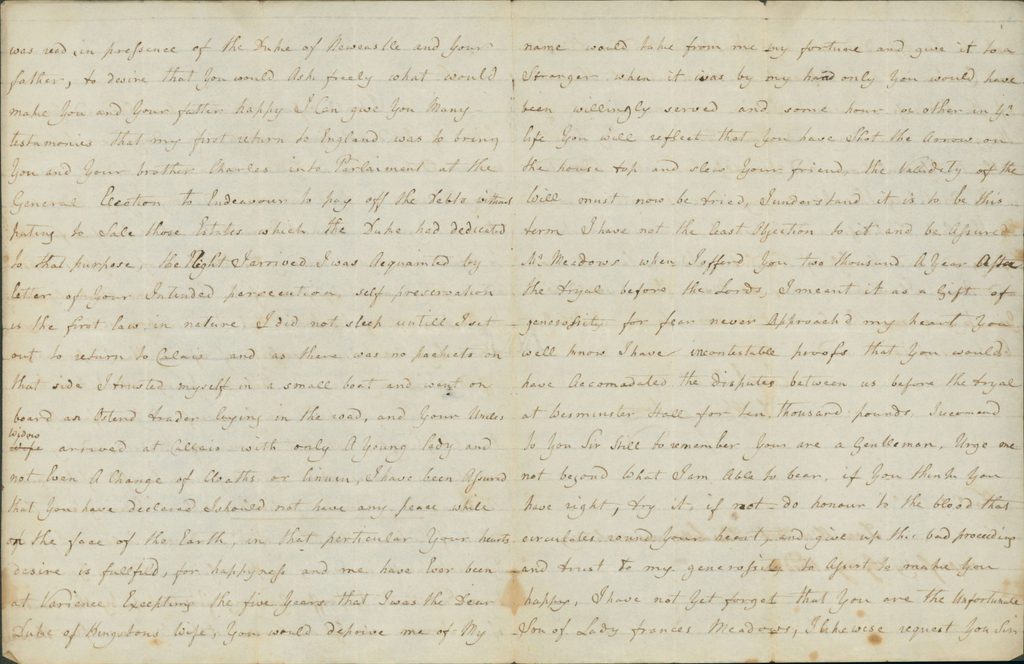
The below letter is from Chudleigh, dated November 1778, and dictated to a maid (“I was ill in bed. This letter was wrote very imperfectly by my maid.”), written to Evelyn Meadows, nephew of the Duke of Kingston. In it, she pleads with him to drop the suit of bigamy against her. She states she offered him 2000 pounds a year in settlement. And ends with “…my state of health is impaired by this last sickness and shipwreck, I am too much fatigued, and the loss of the Duke I dayly lament more and more. I love his memory so much that I would wish you to give me the smallest reason to say I will yet be your friend and humble servant…”
After recovering from her illness, Chudleigh did not hide or disappear; she went on a grand tour of Europe. The disgraced Duchess arrived in St. Peterburg aboard a ship proud and gallant, bedecked in silver and carrying exotic treasures, many of these illustrious prize’s gifts for one of the most powerful women on Earth, Catherine the Great. (2) The yacht’s hull was adorned with her namesake, Duchess of Kingston.
Elizabeth Chudleigh would pass near Paris in the year 1788 on the eve of the French Revolution. The exact location of her burial is unknown, but she is survived by her many estates, art collection, and dramatic story.
Sources:
(1) Laneri, Raquel. “How a 56-Year-Old ‘Bigamist’ Duchess Became Most Notorious Lady in England.” New York Post, 5 Mar. 2022, nypost.com/2022/03/05/how-a-bigamist-duchess-became-most-notorious-lady-in-england/. Accessed 05 Oct. 2026.
(2) Ostler , Catherine. “Crazy Rich Georgians: Elizabeth Chudleigh & Friends.” Aspects of History, 31 Oct. 2021, aspectsofhistory.com/crazy-rich-georgians/. Accessed 05 Oct. 2026.
(3) Rendell, Mike. “Holme Pierrepont the Bigamous Duchess of Kingston.” Holme Pierrepont Hall, www.holmepierreponthall.com/elizabeth-chudleigh.html. Accessed 08 Oct. 2026.
Images and letter from The Harlan W. Hamilton collection of correspondence unless otherwise stated.